
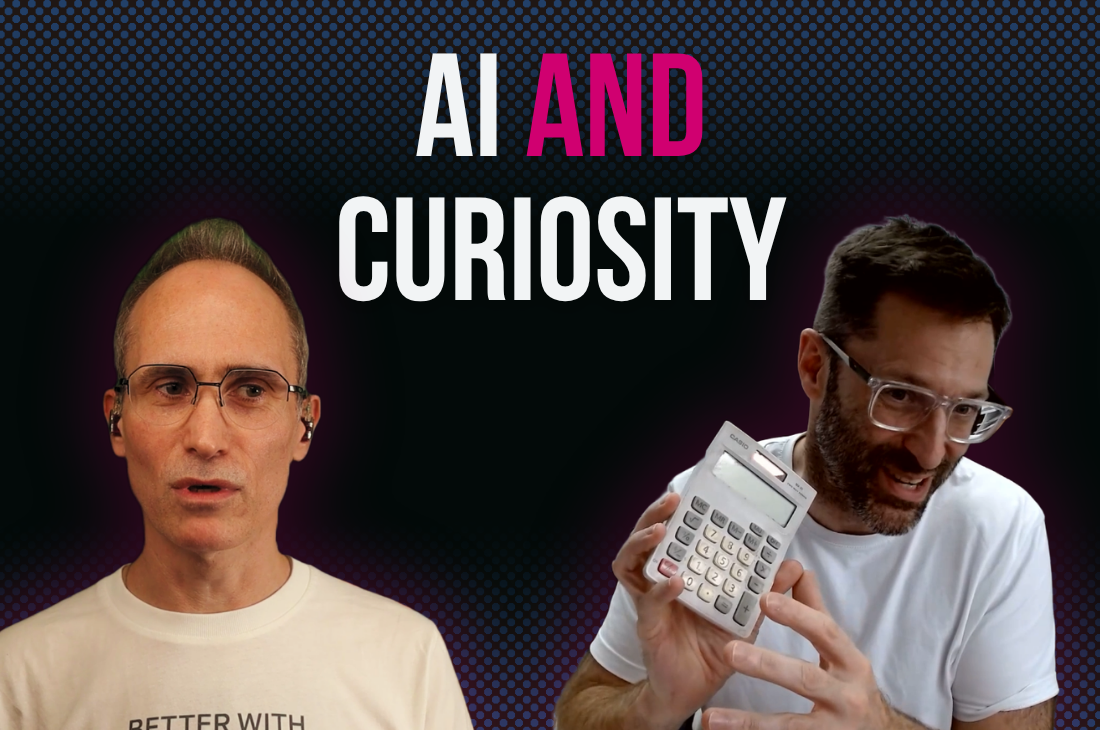




A ten year old is taught in school that there are four states of matter. He goes home, asks ChatGPT, and comes back with fifteen. Eleven confirmed, four still debated. Nobody set him that task, and that small moment is where this whole conversation about AI and curiosity starts for me. My guest is Rob Dixon, a keynote speaker and trainer who builds things live with his audiences rather than talking at them, and that boy is his son Raymond.
Why AI and curiosity might be the real story
Children ask why. Then they ask why again. And eventually we run out of patience, or answers, or both. Rob's point stopped me: this is the first generation whose curiosity can actually be satisfied. They can keep pulling the thread until it ends. He compared it to his own childhood and called it an alien concept. Hundreds of millions of children now have that. We have absolutely no idea what they will build with it.
Execution is becoming worthless
Rob splits any piece of work into three parts. Purpose, why it should exist. Execution, actually making it. Judgment, deciding whether it is any good. For an author, execution used to swallow 99% of the time, and that effort was itself a kind of quality control. Nobody wrote 20,000 words on cucumbers by accident. Now anyone can produce anything in seconds, so the effort no longer proves anything. What is left is knowing why the thing should exist, and whether it is worth keeping.
Everyone is about to get promoted
The bit I keep turning over is that this is harder, not easier. Purpose and judgment burn more brain cells than execution ever did. Rob frames the shift as a promotion. Your old job gets done by AI, and you move up a layer to delegating, checking, deciding. We already know how to do this, because it is what we do with people. The question becomes whether you trust this co-worker enough to put your name on its work yet.
What stays valuable when machines do the rest
Purpose. Judgment. Empathy. Authenticity. Plus continuous learning, which Rob treats as a category all of its own. Empathy only counts when another mortal human is doing it. AI can emulate care perfectly and it still will not land the same way as the person who noticed. And authenticity explains why live music has grown while streaming took over everything else. We went digital, then went looking for the real thing.
Rob calls this the best time in history to be alive, and he means it practically rather than as a slogan. Find a use case. Build one thing. Build another. If a ten year old can outrun the national curriculum on a car journey to school, the rest of us have very few excuses left.
Connect with Rob Dixon:
LinkedIn: https://www.linkedin.com/in/robert--dixon
Website: https://www.dixonai.com/
This was made with humans.
Your host - Shaun Phillips
Editor: Glen Boswell
https://astralforgefilm.com
https://www.instagram.com/thebozzyman
Original music composed and produced by Brokli - https://youtube.com/@iambrokli
Original logo illustration and in video podcast graphics by Jesse Rist - https://instagram.com/jesse_rist
Follow us for episode clips https://www.instagram.com/betterwithhumans
All episodes and news at https://www.betterwithhumans.com
Want to watch episodes instead, check out https://www.youtube.com/@betterwithhumans?sub_confirmation=1
Connect with Shaun on Linkedin - https://www.linkedin.com/in/shaunph/
Introduction
0:04 AI is going to be 27 times more powerful in 12 months, 750 odd times more powerful in two years. The impact on human or cognitive ability to figure things out. Let's talk about it and let's realise what we're doing here. We're trying to build things and get good at building things. A 10-year-old has been taught there are four states of matter. He goes home, asks chat GPT and finds that there are 15. 11 confirmed, 4 still debated.
0:31 Nobody set him that task. He was just curious. My guest today, his dad, says that's a thing we've never had before. Children ask why and eventually we run out of patience or answers. Now their curiosity can actually be satisfied. He thinks we've no idea yet what that generation will build. The rest of this episode makes the case that being able to do the work is about to be worth very little.
0:57 Writing the book, the code, the report. That part gets commoditised. What's left is knowing why it should exist. And whether it's any good. And that, he argues, is harder work, not easier. We also get into four things, he says, stay valuable when the machines can do everything else. Stick around to hear more.
Meet Rob Dixon
1:16 My guest today is Rob Dixon. Rob is a dynamic and high-impact keynote speaker who redefines what it means to learn by doing. His sessions typically combine the inspiration of a keynote with the interactivity of a workshop. The result is an energetic blend of storytelling, live demonstrations, and hands-on learning that leaves every audience inspired, skilled, and ready to act. Whether speaking to 350 executives on stage or leading a half-day masterclass,
1:43 Rob delivers immersive experiences where participants do not hear about AI innovation, they build it. So Rob, yeah, great to have you on the podcast. Thank you very much for having me, Shaun. And I think really what stands out to me, and having sort of done some of your training as well, what stands out to me is this thing about building. I did something many years ago, I trained the trainer, where somebody shows you the steps they do.
2:09 And it was making an origami lily flower. And I can still do it, I don't know, probably 30 years later now. And I think that's part of the power room when you're training, but you're also building along at the same time.
AI as an enabler of building
2:23 Yeah, I always think if you, with AI, the main, and AI is an enabler of innovation. What does innovation mean? It means creating something new. That, you know, you're going to create something new that wasn't done before. Could be a process, could be, so you're always building something. You're building a new process, you're building a new product, you're building a new value proposition, you're building a new dashboard or form.
2:49 So it could just be a prompt, a reusable prompt, but you're creating something. And that connection is key. So whether you're on a personal upskilling journey, whether you're an organisation that's trying to transition to AI, whether you're trying to build it into teaching, whether you're trying to do education, the output of success in that should be seeing the behaviour
3:15 emerging in those you're working with, building things. Therefore, let's look for that. Let's talk about it and let's realise what we're doing here. We're trying to build things and get good at building things with AI and talking about AI, making lists about AI. Discussing about AI, going to conferences on AI, reading books on AI, doesn't change anything. It's all about building and creating things because that's what AI is.
3:43 It's an enabler of your purpose. It executes for you. It creates stuff for you. So immerse it within the learning, immerse it within the talk. You know, if you're not doing something with AI, I don't think you're really there. You're just ticking a box. Yeah, absolutely. Lego comes to mind for some reason, but I think we all have that kind of element of loving to build things.
4:10 And as you say, actually, AI becoming something that enables us to build some of the things that maybe we couldn't build before. I've used it myself for a bit of coding. I've done a little bit of coding in the past, but I'm not a programmer. But being able to go, actually, I can, as you said, I can set an outcome and say, well, I want to build this to do this particular thing. And I can do that with AI. It can take some time. It doesn't necessarily mean I could do it overnight. And it's not necessarily perfect the first time around. But I can learn my lessons from that, go back and take those lessons on board and then build something better the next time.
4:41 Yeah, I think that's exactly. And Lego is a great example. And also, as children, we naturally did this. We, as children, before we went to school, would go around, play things, find stuff, explore it. And then we start putting things together and building things and playing. Give a load of kids. Give a load of cardboard boxes. They'll build a den. They'll create something. We naturally play, explore.
5:09 And then the next thing we start doing is building and creating. And sadly, the education system, plus real life, tends to squash all of that out of you and says, this is what you do. You follow these instructions and that's your role. That's your job. That's that's your box. That's what you stay bounded within. And maybe you even you're a doctor. There's a whole load of guidelines of what you do. You know, you. You really skill your computer. This is how we operate.
5:35 There's this framework that locks you into a process and that building and playing, exploring and then building and creating new things has been flushed out of us in the economy. Why?
The old bottleneck was knowledge work
5:49 Because the bottleneck for value creation pre AI and I like to think of the date 30th of November 2022 as this inflection point. So pre that date, the bottleneck. Was knowledge work. And if you look at all the jobs in the economy and the roles. Doing these difficult knowledge, things required a lot of training and expertise to learn processes and how to do it.
6:14 Coding, surgery, medicine, law, lots of deep knowledge, work and middle management, you know, lots of creatives and things. They're all skills and things that you need to learn. And if you could just get more of those people, the economy would grow more. So the bottleneck was these deep skill knowledge work. What AI does, it loves a deep skill knowledge worker because what's that? It's just a prompt and you just take all of that.
6:41 This is how you do this deep skill knowledge thing. Lawyer, doctor, contract, whatever it is, coding, pop it in your prompt. And if you've gathered all the context correctly, out will pop the result pretty much. And so what's left for us to do? It's create new stuff. It's purpose. That's the new bottleneck. It's coming up for new things. It's what you're going to do, what you're going to use AI to do, and what fundamentally is that you're going to be building things.
7:07 You're going to be creating something new. And so initially, getting people to realise that shift and move away from I'm learning something like a process to I'm playing with something, I'm exploring it, I'm building a capability to build and create new things. And that build and create new things is innovation. And that's what AI is all about. It's about, it's a great enabler.
7:33 It's an enabler of innovation and progress and Legos, if you think about it, is a great little brick version of that, isn't it? So it's all there and you want people to play, but eventually you start creating all kinds of amazing things. And I think that's a really good analogy you've sort of, you've drawn on. We very much try and build that into what we teach individuals on our training courses, but also when we're helping organisations, how do you enable that at scale?
7:59 How do you get the organisation to be building and creating? And, you know, it's a challenge, but it's not easy, but the rewards for those who can adjust to this new economy, this new purpose driven economy are vast. Yeah, I think it's really interesting what you say about purpose, because we see these things where we term as AI slop, where we're not actually really giving enough context or it isn't really the purpose is what it could be to create something that might be something that's supposed to be funny or something.
8:31 There's always a purpose. I mean, it's somewhere, but if we don't actually, if we don't actually really think about what do you want to achieve from that or expand the purpose into something, what does that, how does that look in terms of how do you go from this, this, oh yeah, I'm just going to write something because I can just write in a chat to something that's really meaningful.
Purpose, execution and judgement
8:49 Yeah, I think if you think about the pre 30 November 22 economy, the knowledge constrained economy, if you can do something like write a book, write a blog post, produce a computer game. Make a PowerPoint presentation, the production of that thing, the artefact, whatever it was you're making within it had three elements. There was the purpose.
9:15 Why are you bringing this thing into existence in the world? What's the point of it? What's the value of it to you and others who wants it, the execution, the actually creating the thing and then the judgment, the bit at the end where you have a look at it, I think, does that really meet the purpose? Am I happy for it to be finished? Or do I want to change it or tweak it? Iteration. I just take something like writing a book and do a time and motion study on the person who writes the book. What percentage of their time was
9:43 thinking about why they're writing the book? And what is the reason for the book existing in the world? What percentage of the time is actually doing the writing, the drafting and going through it? And what percentage of time is like reflecting and thinking about it and changing it? 99% of the time, pre-AI was writing the book. It was, if I'm an author, I'm writing. Yeah. And a lot of that,
10:10 that is because you can't produce a hundred versions of that book, you're building the purpose and the judgment into the process of writing. So the P, the purpose, the execution and judgment are all intertwined in the task. Okay. So people who were authors would generally be pretty good at bringing the book to the table. into the world because they've spent a lot of time producing this thing. Therefore it kind of,
10:36 by default, there was a reason for them committing all that effort and they wouldn't have kind of got there if they didn't have judgment. So just the fact that you could write the book, you could produce the software, you could stand up and do the comedy routine for an hour. The effort to go into it kind of thing was validation that there was going to be quality in there. There was going to be some meaning. And what AI has done, it's basically automated.
11:01 It's got the potential to completely automate and replace the execution part of something like a book, a software code, a comedy routine. You can just say, write me a one-hour comedy routine. You've got one. Write me a book on cucumbers. Boom. You've got one. Yeah. The question is, did the world really need a book about cucumbers that was 20,000 words long? Did we really need that comedy
11:27 routine that was on whatever it was? And then was it any longer? Was it any longer? Was it any longer? Was it any longer? Was it any longer? Was it any longer? Was it any longer? Was it any longer? Was it any longer? Was it any longer? Was it any longer? Was it any longer? Was it any longer? Was it any good kind of thing? So now anybody can create anything. I can write an analysis of your X-ray. I can take your MRI scan and run it across diagnosis and produce a comprehensive report. But why? Why am I doing it?
Execution becomes a commodity
11:49 Is it any good? What am I looking for? The execution bit is being commoditised as AI expands. And there's a function there between it gets more powerful, it can do more, AI is going to be 27 times more powerful in 12 months, 750-odd times more powerful in two years. I think it's something like 500,000 times more powerful in four.
12:14 Quoting figures from David Sachs, the US czar there, but it's been following that pattern. As AI gets more powerful, it can do more. But also as the individual becomes more AI literate, and they connect themselves to the right tools and connect their data and context to AI, they can do more. So there's a kind of a multiplier going on in that execution bit. It's racing away. You're getting more capable, but the AI is getting more capable too. So that's racing away.
12:43 So execution is also almost becoming commodified. It's almost valueless. Being able to write a book is almost worthless. But what's left? When you've got millions of books? In a world of abundant quantity, quality has a premium. And what's quality? It's something that has a reason to exist. Yeah. Why does it exist? Because it tells a story. It fills a need. And judgment,
13:08 which out of the hundred versions out there is good? And those purpose and judgment skills are becoming far more valuable as we move forward. Once you kind of realise that's what's going on, and the role of the human still exists, it's just we're now in purpose and judgment, and we're not in execution, away we go. Now, there's an extra little category to this, where that purpose, execution, judgment model, we see AI can do purpose as well.
13:37 Great. Well, that's now, if you imagine you've gone up a level, there's now like the boss of the book writer thing that was underneath. There's still the purpose of the next level up and the purpose of the next level up. So you start to move up the hierarchical change, where initially AI automates the task, then there's the purpose and the judgment, but then you could go a level up and a level up and a level up again. But there's always a human at the start of the purpose. And the AI can bring abundance in between. So this is where we're at.
14:07 And individuals notice this as you transition to being a very, an AI enabled individual, you'll suddenly find that every idea you've got, you can bring into reality really quickly. And you very quickly get weighed down with all the stuff that you've got to read the outputs and give feedback to the AI to get it to a good version. And your output shoots up. But there's so much time trying to think. Think out what am I trying to do here?
14:32 Why am I doing it and then comparing it to the output and going through it, the execution of it is disappearing. So it's very exciting. But converse to popular opinion, I think it's actually mentally more taxing. Because purpose and judgment uses far more brain cells than execution. One is a kind of a repetitive skill and the others are, you're really working your mind to come up with a solution.
15:00 And the others are, you're really working your mind to come up with a solution. Why am I doing this? And so it is a very high level question. Of course, on the AI-Slop angle. If you're lazy, just want to churn stuff out. You can by all means use API to churn out that thing you can have a slot. And. You can already see that pattern where the world is going to be swamped. And I think.
15:25 Real purpose and meaning and quality will only be more and more valuable. So. Get. With. The AI. the programme early and there's a big role for humans in that area yeah absolutely and it's
Is AI dumbing us down?
15:37 interesting to think about i mean there's you say there's been elements of people talking about the impact on you know human or cognitivity or ability to figure things out but of course that really comes down to how we're using it as you're saying how what's the purpose we're setting for it so the other day i had to work out some areas i was focusing on and how i was going to break those things down and actually for me i was like i think it will be useful for me to think about it for me
16:04 to think about that thing so actually if i'm then going to take that and give it to ai i've already laid out i've got i've put some thought into that and actually took took me quite a bit of time as opposed to what i could have done actually giving it all information and said to you and i could have asked it to folk what do what do what do you think i should focus on but i wanted to make sure that i narrowed that down to me setting the purpose this is these are the areas where i focus before i then go and determine how should i do that how does that fit in or even get ai to
16:33 potentially look at it and say well have i missed anything yeah i i think there's a couple of points on this and is it dumbing us down or is it is it reducing our cognitive ability ai is a multiplier of human purpose if your objective is just to have the easiest life possible and get the most out of it with the least
16:58 effort and you're not curious as to how the world works AI will multiply that and you will become lazier and you will no less no less and you will just be able to do your homework quicker etc etc and cruise through loads of things and you'll probably be more successful than you were in your previous cruising and getting away with nothing because it'll it'll raise the bottom bar but your awareness of what you're doing will will will go down
17:27 just I like to think of it just a bit like a like a child if you just want to remain a child you can play you can have loads of fun you can do all kinds of stuff but your parents deal with all the consequences your parents make sure you have a home your parents make sure you eat etc etc and AI if you want you can just live your life like a child and for some people they'll go that route because that's what they want that's that that that for them is their their life choice
17:54 their purpose and it can enable that but if you're curious or you're ambitious or you want to change or move or do or experience new things
Raymond and the fifteen states of matter
18:07 then AI would enable that now I've seen this very personally with my own son and I was very worried about do I my son by the way 10 called Raymond I'm thinking re hman Raymond and I was thinking do I introduce him to AI because he's learning to code, you know, he'll just vibe code everything. He won't really learn, you know, how to code and how to do the subject. And I thought it would be a bit hypocritical if we were an AI enabling
18:37 transformation business doing lots of training and helping, if we didn't actually embrace it with my own child. So I showed him how to do it. He did some vibe coding. He built all kinds of stuff with it. He was using it to do research and things. And this was really good. A couple of things happened. Driving to school one day with him. We had a really nice drive on the way to school because, you know, there's no phones, no mobiles or anything. And we have a conversation,
19:03 10-year-old to grown-up, to dad. And one day we're talking about, I said, what do you do in school at the moment? He goes, oh, we're doing states of matter. I said, oh, states of matter, I know about that. There's three states of matter, solid, liquid, gas. And I'm like, he goes, no, no, dad, there's four, solid, liquid, gas, plasma. I was like, I'm not 100% sure if plasma is a state of matter. He goes, no, it definitely is. And that's what
19:32 they taught us that. He goes, I'm not sure because I don't want to tell him if I don't know. So you shouldn't really do this. But, you know, in the queue at the traffic lights, quietly just typed in on Google. He goes, are you typing that into Google? And I'm like, well, he goes, I've already done, I've already put it into ChatGPT. He goes, there's actually 15 states of matter. Four of them are in the national curriculum. And that's what they currently teach us at school.
20:02 There's 11 that are confirmed by scientists. And there's four that are currently debated by that. That's the situation of how it is. And I've already checked it. I've already searched and already know it. I was like, where have you got that? He goes, I looked up in ChatGPT. So did you teach it? Did you tell the teacher? No. I wanted to know, he said. He was curious. So on his own, he's gone to school. He's learned about that subject. He's gone back home. He's gone to ChatGPT. He's gone on a journey. And on that journey, he's discovered there's 15. And he's
20:32 like, why are there 15? When they're teaching me there's four at school. And then it's explained to them the curriculum and everything. So he's learned this huge context around states of matter way more than me. And it's not him cheating on his homework. He's a child. He's learned something. He's because he's curious because he's multiplied it. So it's really enhancing that. Now he could to do his homework, just say how many states of matter are there? Boom. And here's the homework. Do it. But he's used it to do it. Now, the second thing that
21:01 happened with Raymond was he's been learning to code Python. So he's vibe coding. He got stuck on his Python coding that he's working on. And I was like, why don't you just take a screenshot and put it into Claude? And he goes, I want to work it out. I want to solve this problem. I goes, just take a screenshot with Claude. Can you help me, dad? I said, well, I just take a screenshot because I'm working.
21:26 And he goes, well, I'm trying to figure it out. And I said, well, I'm trying to figure it out. Trying to figure it out and doing whatever he did. And eventually he cracked it. And then he explained it to me. I didn't really understand it because I can't code in Python. But he'd figured out whatever it was he was trying to figure out, old school. And then he checked it in AI
Curiosity that can finally be satisfied
21:41 because he wanted to know. And it suddenly just struck me, what's going on here? If you think about children, you know, when they ask why, like you get a five-year-old, six-year-old, they go, why? And you answer as best you can. Then they go, why again? And you answer again. Why? Why? Where does that end? They'll keep going, why? And eventually you're like, go and ask your mum. Or I have no idea. Or just go away. Or you make something up because you
22:12 don't know the answer anymore. But eventually you lose patience with it. And the child's curiosity is unsated. They never reach the limit of it. When you give that child AI and they're curious, they'll go, why, why, why, why? Until their curiosity is sated. It's fulfilled. Now that, when I compare that to my own childhood, it's an alien concept. I was curious about loads of things, but I never got to this point where I
22:39 felt I reached the end of that why, the why loop. But every child in the world with access to the internet now, 5.8 billion people, to how many children that is in the world, but you know, hundreds of millions, now have the ability to have a sated curiosity. And I think, coming back to your playing with Lego, the hope, I think, that we have for the future with AIs, children are naturally curious. I think that curiosity gets squashed out of us as we get older.
23:09 And I think actually giving children access to AI and allowing them to go, why, why, why, why? I think it's quite exciting what that will be like. A world where curiosity and purpose and exploring is rewarded and easy and you can go down that road. Who knows what these kids will produce with access to that type of facility, you know, when they're
23:34 adults? I guess we'll find out. Yeah, absolutely. Yeah, that is an exciting prospect when you look at it that way. And actually, it kind of also sort of partly answers a question, quite another question I was going to ask. Because somebody asked, my last guest was talking about how the level of trust that young people put inside of what the results they get from AI. But of course, what you're saying, if you then, if they're taking the, they're going, okay, well, yeah,
24:01 you've given me that and asking, well, why that, why this? Then that's one of the ways you uncover, don't you? The inconsistencies or the, well, actually, that sort of makes sense, but I'm not quite clear about that. And I see that myself when I'm using, when I'm doing some vibe coding and I'm building, building a system and I, and it will come back and I'll go, why would you do it that way? And then sometimes it'll come back, actually, you know what, that's not a very good way to do it. Or I'll go, so, and now you were saying, I'm,
24:26 I'm continuously doing that purpose execution judgment cycle, but much quicker instead of it just being, you know, doing it on, on, on constantly. And in some cases, as you said, there's so much information coming back. So I use a, a plugin called superpowers in code and which is the other specs and documents, but it's so much comes back. And sometimes I just put it in full auto. I know it's now Claude made that the default. So I put it in auto because I'm going, okay, I'm going to need to pass off. As you said, some of that judgment, some of it and put to that,
24:56 for you to continue to do this. And then at the, but at the end result, I'm still judging
Delegating to AI like a co-worker
25:01 the output and go, is that working? That delegation bit, a really good analogy with AI is not computers. It's human beings. And just think about what you do in a business. Like when you start a new person in an organisation, they do what they do. Now let's imagine your four levels up in that organisation. And let's just drop down to that person's immediate supervisor. There's four layers in the organisation.
25:26 You bring that person in that person's responsible for all the outputs of that department. You don't put your new starters outputs and qualities and reports and quotes, whatever they're producing straight out to clients and customers or into the code base or whatever you're doing without someone checking it, someone verifying it and so on. So you'll give them a bit of purpose. You let them execute, and then you're applying that judgment. Are they ready yet? And you'll kind of micromanage them in a while, or you'll put them through some
25:57 quality controls or whatever, until a point in time where you judge that that person is okay. And then suddenly you'll let them loose on clients and et cetera, et cetera. So you're kind of using your judgment at that level to see where it is. But now imagine that that person gets promoted. And now there's someone doing the same thing with the person on the tier down. There's two or three people working to produce a report that
26:22 this person's coordinating that's going to go out. But now this person at the second level, their reputation's on the line with that report. And you could go up to the CEO, he's about to say, we've done some work as a company, this is our outcome. And your name's on it. And you can go all the way up to like a prime minister, can't you, where this is our big initiative, our big plan. If that's wrong, you'll be out of a job with egg on your face. So as you're
26:50 getting promoted up through an organisation, you have responsibility for people. You actually already have this skill set as a human being why am I doing it you're delegating execution to a layer down and then as you get promoted you you're now managing people or managing people just like you're delegating that judgment where you flip the the air on but you you're expressing a judgment of what to delegate and what not to delegate and you do that when you kind of trust it so as humans you
27:16 go through a period of time where you've owned it you've got to know it can do this task so you trust it to make those decisions and I that I think is people don't like anthropomorphising uh AI but in terms of how to work with it it's it's much better to think of it like a sort of a human co-worker and do I trust this human co-worker now to produce things that I'm going to put my name on and you form that relationship with it and then you you move you you move you move on again so yeah I think
27:50 you're exactly right and and now my it comes back to we're saying before it that purpose that delegation that judgment suddenly is becoming the value that I'm bringing to the organisation to my
Every job changes, everyone gets promoted
28:03 work etc and the execution bit is getting very difficult different I think what we're going to see in the economy is all jobs are going to go is the wrong word all jobs are going to change and what's going to happen is everybody everybody is going to be promoted and we're all going to have our old job done by AI and then probably at some point we'll get promoted again and then there'll be AI doing AI and we'll keep getting
28:32 promoted and like we'll have all these people working for us just like at the moment you know the calculator has that would have been a team of people doing all these sums the spreadsheet it's like you've delegated work to a system now we've delegated deterministic software coding maths to computers but now we're going to be able to generate to delegate uh generative
28:59 and non-deterministic uh problems and knowledge work to to to AI so we're going to have this same kind of kind of process of of how of how we do and for those who embrace it the opportunities are vast for those who want to be lazy and just sit back you know then the opportunities are vast but in a different way and we will see there's going to be a big shuffling of where the value is I think at the moment you
29:28 look at look at look at how paid different jobs are the high executing knowledge worker deep expertise jobs are very highly paid lawyers judges you know really good high quality writers content creators coders surgeons interpreters of complicated sets of data data analysts these are the high paid high high skilled jobs because they take a long time to learn and do they're not going
29:57 to be the high paid jobs of the future the high paid jobs of the future are going to be the people who can innovate people who've got great purpose people who've got loads of ideas people who've got really good judgment about things that haven't been done before who can make good calls of to what to use the the AI's resources and compute resource on where what should be pointed out where's where's the opportunities where's the new stuff because we're all going to be producing more and more doing creating all these new kind of things who's able to figure out the best way to
30:27 to get on that path and you forget about all the breakthroughs AI is going to go on just for a moment just take health care just to get world's best health care available to every person on the planet how much innovation has evolved to move from current method of delivery health to health care to everyone on the planet having equivalent world's best best delivery health care there's all this information that's going to be available to everyone on the planet and it's going to be all kinds of lowering of costs processes distribution manufacturing surgery there's so
30:57 much opportunity for human beings to figure out how that's deployed using ai before you even make any breakthroughs and then you can you know what would a world be like where the current best is available to everyone because through efficiency and productivity of ai you you can lower the costs of these of these productions down to the whole thing and you can apply that just to so many so many sectors and so many things are out there i guess this is where elon talks about the the world
31:27 of abundance i mean there's never going to be we can't all have the best seats in the house we can't all you know necessarily have the prime real estate on the you know on the thames right next to big ben but in terms of stuff i think that we're on that journey yeah and you see you mentioned about the the higher paid jobs so what are your thoughts on but for the creatives like
31:52 you know the the artists the the actors what is it what do you think it looks like for them moving forward well i i've written uh these are all coming from my academic papers that we're just
Four things that stay valuable
32:04 talking about now a lot of these ideas if you go to just reference rob dixon.ai i if you're really interested you can you can plow your way through the 60 page paper i wrote on this but uh five things are going to be uh valuable that humans can do and those five are purpose related activities judgment related activities so i think
32:31 we've covered those but the the two others that are very important that the computers cannot do ai cannot do empathy and authenticity the final one by the way i call is continuous learning which is a bit of a category on its own and the reason i say continuous learning is because it's continuous learning is important in terms of humans creating value is if you're going to be
32:57 doing anything in the world of the future you need to understand it and it's changing so fast you're going to have to be keeping up with it therefore i don't think education fits as a block when you're kind of like 5 to 21 anymore or whatever it's going to be a lifelong part of something that you need to do all the time if you want to have any relevant contribution society because otherwise you just lose track of what's going on so that's the first thing i'm going to talk about but then the second thing is you know what do we have instead of doing education full
33:26 time maybe we end up with a four day week and day five we're always learning and keeping up who knows how that works but you can kind of imagine but the other two that i think when we're
Why empathy will be worth more
33:36 talking about you know lower paid jobs or people who perhaps aren't going to have loads of ideas and all this stuff empathy and authenticity are going to be i think really high value so what's empathy empathy only has value in and of itself when another mortal human being is actually empathising with you so ai can emulate empathy you know it can do everything the same it can get you it can talk to
34:06 you but it will never be the same as another fellow human being expressing empathy with you so when my partner says something nice to me or compliments me or recognises an emotional state that i'm in and connects even if ai can absolutely nail that better quicker more frequently it will never be as valuable as my partner actually connecting that but you can apply this not just in your
34:35 relationship just everywhere if i go to a restaurant and the server the maitre d the chef or someone greets me in a way recognises something shares shows some care about my enjoyment of that moment or what i'm doing that's really nice another human being is taking a little bit of time out of their life to notice that you know maybe this would be nice or whatever or something they've done something
35:04 nice for me that's got value would if that was a robot would i value it more if that was a robot i would be that would lose that would definitely lose some value now let's just two scenarios here one everything's perfect and there's a human being do it who really cares i'll have the human every time option two the human being doesn't care the service is terrible i want the robot
35:32 restaurant please so everything where there's a human element of service or connection or doing things there's going to be tons of value in that especially in a world full of ai i think the other thing that's really important sales relationship purchasing if i'm going to a job that ai could read my face it can manipulate me it's smarter than me how do i trust what the
35:58 culture of that company is like from an ai because it's it's totally can outplay me in every which way my only chance is to have my own ai to kind of try and figure it out but you know but if i meet a human who is working at that company now it's levelled up the game now i can empathise with that human they can empathise with me there's a little bit of like the humans saying that oh it's all fantastic here but now i can you know i can read body language there's connection there's
36:24 empathy because they're just the same as me so i can figure out is that a nice company is it a nice place to work what's the culture so much stuff will go on in that communication therefore if i was going to work for a company and make a big change in my life i would always want to at some point i don't mind being pre-filtered by ai but i would want to talk to a human at some point to just get that empathise what it would be like to be in that role and you can apply that to career changes you could apply
36:50 to do major contracts deals sales negotiations any kind of contractual exchange between individuals businesses organisations companies empathy is going to be high value and we'll probably have more time to spend on it you know rather than doing squashing all our interviews into like hour hour hour maybe we might spend a day with a new employee because we've got more
37:16 time freed up so the interview process might run over a week we will get back to you when we've had them we'll get back to you when we've had them so if you're up to date with your stuff of course i would say the contracts the logistics but it's good to start with the ingestions so i would say the short list is a day with each person hanging out with them doing some stuff and you just get a much better connection and recruitment rate than you previously had who knows where this goes but for sure that empathy is going to be very important another big
37:44 bit if you just take teaching for a minute engagement engagement is empathy so the ai will be able to . all the things, it knows all the subjects, it can personalise it, it can teach 30 children with personalised lessons at the same time, but can it engage them? Yeah? Already my son is like, turn the AI off if it's trying to do stuff. And we know as human beings getting children to be engaged, in fact just getting other human beings engaged is difficult, and as soon as you put like
38:11 a robot or a process in place people have a habit of, if there's no consequences to another human being, people won't engage. So I think that empathy, so there's, you can imagine here loads of jobs in this space, engagement, connecting with things there, there's lots of roles there, and you know, the flip as well is you can apply the same to authenticity,
Authenticity and live experience
38:33 yeah? Your artisanal cheese, your actual live concerts. That's been an interesting thing hasn't it? iPods, Spotify, I think live music's probably gone up. In recent times, as we've been more digital in our receiving of music, and we've gone away from sort of vinyls and the connectivity playing it, we've gone more to streaming it, but now we probably go to more concerts and live music and live events than
39:00 we've ever done before. And it's authenticity. And I think that authentic experience of doing things, yeah? So those for me are huge growth areas. So what does the world look like now, you know? What are the things you're gonna do to your life? What are you gonna go through in your life to be more digital? are we doing at the moment with most of our time we're at work processing stuff on computers and working away and executing things okay so all of that is going to be going away and replaced by us
39:27 what's left we're innovating coming up with new ways purpose we're applying judgment and picking what's the best and iterating really quickly or maybe with with people connecting with them empathetically with more time with less pressure or we're doing authentic things where we're connecting back to our roots or we're upskilling and learning now if that is the world we're heading to that's going to be a fantastic place for human beings because it's
39:57 much closer to what we naturally are and i think it will remove a lot of the stresses and issues of the modern world getting from here to there as an individual in society anything could happen but uh i think the end point looks looks pretty good providing we don't wipe ourselves out along the way but uh i think there's a very exciting future for us there and you know uh there's there's something for everyone in that
40:27 i think yeah absolutely yeah thank you for that and i think this is a great i think it's a great point to kind of you know to land really in terms of the you know you've gone through some of the the challenges and some of the but where the opportunities are and i think that's what has really come out from this is actually there is a lot of opportunity and really it's looking at how do we embrace it rather than say well okay we can stick our head in the sand and go well look it's it's all disaster but often that again it comes from
40:55 maybe lack of understanding of what is possible and how i can manage it and actually the fact that you're part of shaping it as you talked about in any other as you get promoted you're you're shaping the future of what this becomes it's not something that is just that loose and it's just going to become the same thing so i think that's really yeah that's really definitely encouraging so you mentioned your website how other ways people get in touch with you or because just find out
Where to find Rob and closing thoughts
41:20 more about what you're doing yeah so robdixon.ai that's my personal website where i've got my material my books my content but if people want to go on a in particular if you're an organisation who wants help building ai skills uh transforming to you know innovation first organisation or do or even just you're an individual employee worker who wants to upskill we do training uh dixonai.com uh it's dixon with an x d i x o n a i dot com and yeah you get in touch drop us a line
41:54 and uh come and we'll put lots of stuff on that's free as well you know come and come and get in touch and uh join the party really that's great and i'll the links will be on those listening watching links will be on the show notes as well and yeah be sure to like subscribe if you'd like the content and yeah i'd love to hear from people maybe other topics around this that you want to do or comments or responses to some of these things that we're talking about and yeah thanks again rob i think it's just yeah i love the
42:23 future thinking i love this the positivity around what what we could see as we say we don't know for sure but we certainly can have a good go at shaping the future as we'd like to see it i think opportunity is a great word this moment in history no individual has ever had more opportunity for social mobility agency change upskilling affecting their dreams
42:52 than ever before it hardly costs any money it's just a journey you start with a and up skill and then you'll very quickly find you're limited only by what purposes you're what you're trying to achieve what your ambition is and where that takes you and it's so exciting and i wish that message was more out there in the mainstream media often it can be so gloomy and doomy so i think it's great to finish on that positive note
43:20 opportunity this is this is the best time to be alive embrace it go on that journey upskill you you don't need anybody to help you or anything you can just go out there find this stuff out yourself and just start on that journey and and step one is find a use case step two start building some things yourself and just go on that cycle build one thing build two build three and and and see where you end up and you'll end up who knows where you'll end up but it'll be a long way down the journey of it of
43:51 finding out what that opportunity exactly was absolutely yeah thanks again for joining us rob thanks shaun lovely to uh spend the time with you