
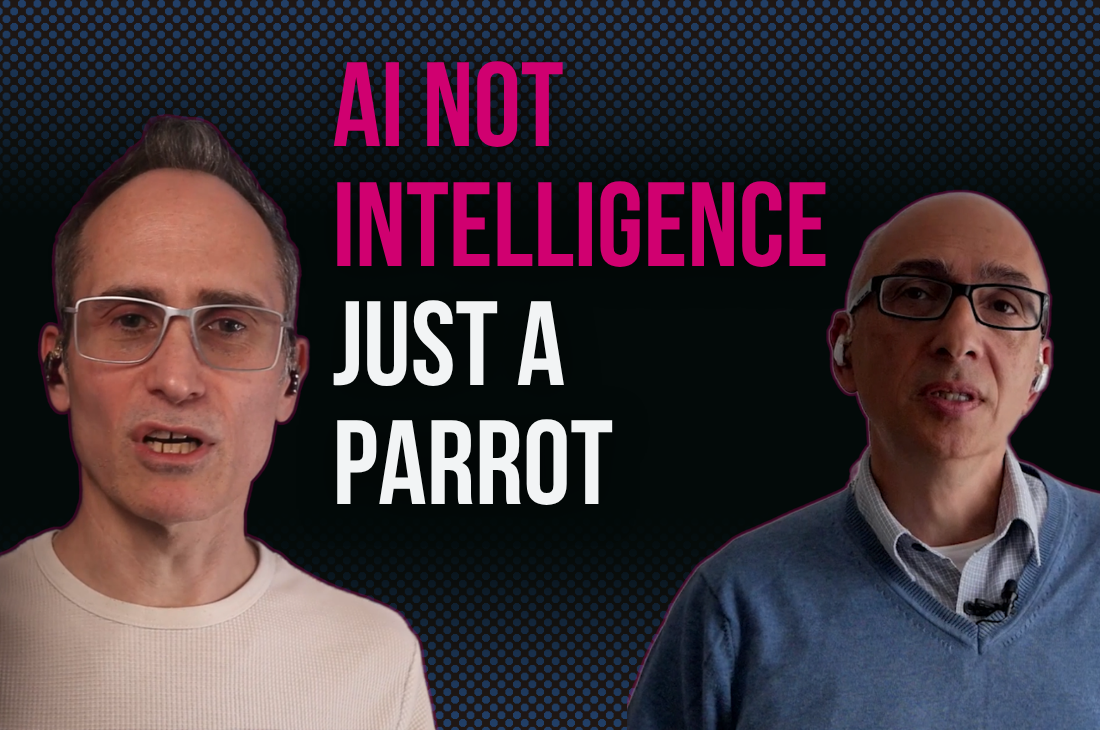




AI image generation has come a long way from six-fingered hands and uncanny eyes. Leslie Coelho spent 40 years in software engineering, from writing safety-critical aviation code for the Airbus A321 with no internet and no libraries, to experimenting with AI tools in retirement. That kind of end-to-end perspective is rare, and it changes the conversation entirely.
What AI image generation actually looked like at the start
Leslie and I go back nearly a decade, and some of our earliest AI experiments were on Night Cafe, trying to see who could get into the top five percent of liked images. The prompts were long, the results were unpredictable, and you could almost always spot the tell. Too many fingers. Eyes slightly off. Something in the uncanny valley that gave it away. What's striking now is how far that's moved. Leslie can give a model a paragraph of text and ask for an image to accompany it, and eight times out of ten it lands. That shift from technical prompt engineering to concept-led generation is significant. It's not just better images. It's a different kind of access.
Understanding what AI is actually doing beneath the surface
Before we got to the creative tools, Leslie gave one of the clearest explanations of large language models I've heard. No mysticism, no hype. When you type a question, the model tokenises it into numbers, predicts statistically what should come back, and returns tokens it never understood as words. His analogy was a myna bird in a pet shop saying hello when the door opens. It's not greeting you. It learned the pattern. That reframe matters, because it explains why AI confidently says things that are wrong, why pointing the error back at it just triggers another prediction, and why getting frustrated with it is a bit like getting frustrated with a very elaborate parrot.
Where humans still need to stay in the loop
The tokenisation point connects directly to something Leslie raised about organisations using AI for customer service. One large firm put AI at the front of all customer interactions, surveyed their customers, and found around 70 percent still wanted to speak to a human. They flipped the model. Humans at the front, AI supporting behind the scenes, helping agents answer faster. That feels like the honest shape of where this works well. AI handles the pattern. Humans handle the texture of the interaction. The frustration Leslie described with AI, looping back on the same wrong image no matter how many times you ask it to change, is the same frustration customers feel when they sense there's no one actually listening.
Prompt engineering and getting useful output
Beyond images, Leslie has been refining how he uses AI to write long-form articles, and his approach to prompting is worth sitting with. He treats it like briefing a team. Not just a topic but a tone, a starting point, a conclusion, checkpoints along the way. The model has got better, he's clear about that, but the craft of the prompt still matters. He also described feeding the model writing you've already done, asking it to analyse your style, generate a prompt that recreates it, then write something you've already written to test how close it gets. There's something quietly interesting about using AI to reflect your own voice back at you.
This conversation reminded me that the people with the steadiest read on AI tend to be the ones who've watched enough technology waves come and go to resist the urge to call this one either. Leslie isn't speculating. He's been building, adapting, and paying attention for four decades. That's the kind of voice I want in the room when we're working out what to do next.
More conversations like this
 AI Data Centre Energy: The Hidden Cost. Leslie Coelho returns to count the cost of AI, from data centre water and power use to running smaller models on your own machine.
 AI Character Consistency Tips for Creatives. Glen Boswell shows how character sheets and preparation keep AI-generated scenes believable, and he is honest about where the illusion still slips and a human eye is needed.
 AI Customer Service Done Right. David Levine spent nearly two decades in retail alongside IT work, and explains why customers only ever want two things from you.
This was made with humans.
Your host - Shaun Phillips
Editor: Glen Boswell
astralforgefilm.com
Instagram
Original music composed and produced by Brokli
Original logo illustration and in video podcast graphics by Jesse Rist
Follow us for episode clips on Instagram
Follow us on TikTok
Want to watch episodes instead? Subscribe on YouTube
Connect with Shaun on LinkedIn
Introduction
0:00 Now what you couldn't do before but you couldn't compete with larger organisations but now you can using AI then why wouldn't you use it? If you went into the workforce then it's different to if you're a few years away because it's moving so fast it's like a raging river. I think we are in a time where there are opportunities and there are challenges and we don't really quite know
0:26 where that's going to end up. Let's uncover what is better with humans.
Meet Leslie Coelho
0:33 In this episode I'm joined by my close friend Leslie Coelho who I've known for almost 10 years. Leslie spent 40 years in software engineering and IT and has lived through every major wave of technology. From writing safety critical aviation code for the Airbus A321 with no internet, no predefined code libraries and no AI. So helping Tesco.com during the dot-com boom and experimenting with AI tools in his retirement today. That rare end-to-end perspective is what
1:03 makes him a distinctive voice on AI. He's not speculating about the future. He's lived it, he's been watching this story unfold in real-time for four decades and he still can't stop exploring what comes next. Beyond the tech is an NLP master practitioner, natural biohacker, published sci-fi author and committed lifelong learner. Welcome Leslie. Hi Shaun. So we've known each other as I say for 10 years now and we talk about many things over the past 10 years. Particularly in the last four
1:33 years, AI has been a big topic or something we've been talking about. And I realised so far in the
What is AI? A plain English definition
1:39 series, I've been talking to a number of people about AI and really not explaining it. So I thought it would be good to start off with just giving a, you know, sort of simplified definition of AI for those that may be listening and not entirely sure they hear it around a lot, but not entirely sure what actually is it. Yeah. Okay. So a lot of us will have come across AI in science fiction. If you've watched Star Trek, they always talk to the computer, it does various things. And that may be your kind of vision for what AI is. But actually when most people talk about AI at
2:11 the moment, they're talking about large language models. So AI is actually, there are different flavours of artificial intelligence. So there are large language models, which are the things that do chat GPT and things that people chat backwards and forwards to. There are also other models. Most of those, they're all statistical models actually. What a LLM does when you talk to it is like predictive text on your phone, it's actually predicting what the next word is that you expect to hear.
2:42 And even when you ask it a question, it then predicts statistically what is the most likely answer. And they've got very, very good at doing that. So yeah, that's really interesting and a helpful explanation to bring in something that you say, like predictive text.
AI has no idea what it's saying
3:01 I think the main thing to understand is they have no idea what they're saying. They're not even words. They are just, so when you're talking to, when you write a question to an AI, it tokenizes your question, which means it turns it into a load of numbers. And then it calculates tokens to send back to you. It has no concept of what the words are or what they mean. So, and that's why, um, it can say things that seem very clever or give you back a load of
3:27 gibberish occasionally. So yeah, that's interesting. And I think when you think about that, that's a really great way to think of it because it means often I found this, I get annoyed or frustrated with AI because it's like, why do you not understand? But actually putting into that explanation that is tokenised is when actually it doesn't never know what it's saying to you. And it's only when you point back and you go, well, you did, this is what you said. And then, but even then it's still doing
3:54 the predictive thing, right? It's, it's going, okay, I said something that wasn't correct. Okay. And then it's so that's, that's helpful for me actually to think, okay, yeah, don't get stressed about with this thing. Cause actually all that's happening is it's sending you back information that doesn't even know what it actually is. To be honest, what it's actually doing is parroting back what it's heard other people say, uh, in the same way that if you had, I remember when you used to be able to go to zoos or pet shops and they would have a minor bird or a parrot and it you'd walk
4:24 in the shop, normally a pet shop and the parrot or the minor bird would say, hello. Um, it didn't know what it was saying necessarily. It just knew that when the door opened and the bell dinged, it said hello because it heard other people say hello. And AI is doing the same thing on a much bigger scale. It's taken in all the information on the internet and is parroting it back to you based on what you ask it. So actually that's it. That brings me onto another question. So we've got this
4:53 information coming in from all these different parts of the internet, some good, some not so good, some true, some less, some information that's less true. So that's obviously one of the reasons why we find things aren't entirely correct. We might get statistics that aren't right because the information
Training AI on your own data: RAG explained
5:08 it's brought in isn't correct. So when we consider how do we go, how do organizations go about training AI in terms of ensuring that the information they get is more accurate? Okay. So when you say training, so obviously the language models that we're used to talking to, interacting with are pre-trained. If you've got a corpus of knowledge of your own, so for example,
5:34 you're a company, let's say you've got something like a set of manuals on how to do certain procedures and stuff, maybe guidelines for your customer service agents. The AI doesn't know anything about that because it wasn't trained on it. You can use systems like RAG, which is Retrieval Augmented generation to provide the AI with additional information. How that works is basically what
6:03 you're doing is storing the information in a database and then retrieving the information from that database that you think is relevant and injecting that into the prompt. So when the prompt, when you ask a question like somebody's phoned up and their gas boiler doesn't work, what should I say to them? It actually looks up gas boiler faults, finds them all, injects those into the prompt so that the
6:34 LLM has the context of your question and includes the example information of what it may want to be able to respond with. And then it tries to match that up. That's going to depend on how well your database storage and retrieval mechanism works. And there are different ways of doing that. There's something called this RAG that uses something called a vector database, which again, tokenizes everything you say into numbers and then tries to find. So basically what it's doing is it's creating
7:03 clusters of information. And then if you ask it something and what you ask it is over here, it will return back information from kind of this area of its memory. There are other things called graph databases, which do something similar. They create a graph of connected things. And then, so for example, it might be car is connected to bus is connected to train because they're all types of transport, that type of stuff. So if you ask it transport your question, it'll navigate the graph and
7:33 find things that are related to what you're talking about. Dump all of that to the AI and hope that the AI can sort through it and answer your question.
Rubbish in, rubbish out
7:43 Yeah. So in terms of, so like the examples you gave there, we're talking about structuring data in a way and accessing it, allowing AI to access it in a certain way. Well, it's interesting as we talked, as you spoke, that's what we've got this information covering everywhere. But even if we are using AI internally to actually retrieve and analyse our own information, it's still important that that information is correct. Yeah, obviously, it's an old saying, right, which was rubbish in,
8:13 rubbish out. If you provide the AI with a load of rubbish information that's wrong, it will parrot it back to you. And then you will repeat that to whoever else you're speaking to. That's also the problem that you alluded to earlier with the internet, right? If you just scrape tons of information from the internet, how do you know which information you scraped is correct and which information is wrong? I think the general principle is majority wins. So whoever shouts loudest. So
8:44 what they do is they look at, well, if I found 150 sources that says the earth is flat and three that says it's round, the earth must be flat because more people are saying it's flat than round. Which obviously isn't always the case. So yeah, I suppose that also brings on to things like bias as well. And so this actual ability to really clarify human. Yeah, we need humans still need humans to clarify the information to check
Why people still want to speak to a human
9:13 through. Does this actually seem like it's a logical thing? Somebody was telling me recently, one of the the large firms that had to take and put AI in front of all of their chat, you know, chats and everything out all their customer service front end. And then they did a survey of their customers. And I think it was about 70% or something, maybe even higher number that turn around and said, well, actually, what we want, most thing we want is we want to speak to a human. We want to or having
9:41 contact with a human. So they flipped it around and they've said, okay, right, we're going to we're going to put humans at the front, but we're going to use AI to complement in the back end to actually make it easier for the humans to answer that to get the questions answered faster. And that's responding to us. There's definitely still that need that people want to be able to talk to a human. And there's and it's interesting with you talking about the tokenising and the fact that AI doesn't actually know what it's saying to you helps to understand and see why people get frustrated
10:11 with when they don't get the response that they're expecting, particularly when it's being made to appear as if it's a human. And that's something else that came up recently, as well in a previous episode was actually this whole thing of why are we trying to make AI appear human, rather than actually just get it to do what it's actually good at doing. And rather than trying to actually make it feel like it's more and more human, because when we do that,
10:37 our expectations of responses and how it's going to interact with us are high, are more human like when it doesn't. That's when we get disappointed. Yeah, I think one of the things is obviously if you if you call a call centre or you phone people, quite often there's more to the interaction than just I've got a problem. You may be frustrated or you may make a comment about the weather that's got
11:04 nothing to do with the reason you phoned up, right? Or you might laugh with the other person. And those types of human connection, that emotional exchange that happens when you're talking to other people,
Four years of AI: what has actually impressed us
11:16 that doesn't happen with AI. So as you mentioned earlier, we've been talking about AI for around four years. And I remember some of the first things we were doing was, you remember the nightstudio.cafe, where we were really just trying to create images with AI and trying to see who would actually like those the most. Just thinking about that over those past four years, what are some of the things that
11:43 have really impressed you about the things that have come out using AI? Okay, so a couple of things. One is, let's start with the image stuff. The original images you did took quite long prompts to try and get anything reasonable. And you would end up with people with six fingers or funny eyes, or there was there was always things about the pictures that were potentially not very good. And if you looked, you could spot it was AI generated. Anybody that's seen an AI image
12:12 recently will know that that's improved vastly. Now, I can't draw, you know, I'm not an artist. So being able to get AI to generate images for me is quite useful. Also, what you can do now is you can just give it a concept, you don't actually have to tell it what the image needs to be, you can give it a paragraph of text and say, Can you give me an image to accompany this text? And eight times out of 10, it'll give you a pretty good image. Sometimes you have to kind of prompt it a little bit.
12:42 After that to say, Can you change this? Can you change that? Other times, it just gives you a completely inappropriate image. And no matter how much you ask it to change the image, it just keeps iterating around giving you different versions of the same thing, or exactly the same image over and over again. In those cases, you have to stop and basically start a new chat and start again and try and get it to produce the image you want. So image quality is increased massively. I haven't
13:08 looked at the video stuff because the video stuff that I've seen isn't particularly brilliant. I mean, yeah, if you want a dog riding a skateboard, then maybe that's a great way to get it because otherwise, it's very difficult to train a dog to ride on a skateboard. But they're not, I've not seen stuff that's really, really good. And also, it's still pretty expensive. And obviously, with video,
13:35 you're generating hundreds of frames per minute. So the cost can rack up quite quickly if you're just playing around. Yeah, I've got a friend, Glenn, who is actually going to bring him on in a future podcast. And that's exactly what he's doing. So he's written a sci-fi book that's got dragons, and it's a fantasy. And he's actually doing that. He's creating, he's got an amazing trailer,
14:02 which I'll have to share with you. And we'll get him to share it when he comes onto the podcast. But yeah, that's exactly what he's saying. So he was saying that he uses three different video AI tools. Because one of them is good at really good voices. Another one is really good at the animation. Another one is really good at the landscape, you know, creating the whole picture. And as you say, the cost, you know, the cost, the cost of the credits to actually do it is,
14:31 you know, still pretty, pretty high. But actually, but the results, the results are impressive. And I suppose it's probably, it'd be interesting to see in terms of to create a whole movie, what would it cost you to do that versus if you were going to bring all the people in and everything else to do that? And what would the, you know, what would the differences be in terms of that? What he's done is, is still is pretty impressive for what he's been able to do with
14:56 the tools. I shall wait to see the results. So, so I know you've, you've moved on from, you've moved on from the days that we're just creating pictures just to get, just to see if we can get in the top 5% of the night cafe pictures to looking at other other projects. Do you want to just give us some, some, you know, feeling of some of the things that you've been working on, some of the things you've been able to do with AI in the last few years?
15:23 Yeah. Well, obviously the thing that it started off with was that AI could answer questions. So my first thought was, can I get it to write a post, like a short, like a short piece of text, like a post for LinkedIn or Facebook. And that proved to be relatively, relatively easy.
Prompt engineering: how to get better results
15:44 I then thought, well, what about a longer piece of text? Because the longer the text gets, the more you have to worry about it drifting off into some fantasy land. I can now use AI to write quite long articles. And that's, that's by perfecting the prompting. But the, the AI models have got better. They are, they are definitely better than they were even a year ago or six months ago. But a lot of it still comes down to good prompt engineering.
16:12 By prompt engineering, I, what I actually mean is actually constructing the prompt. So when I construct a prompt, I think about the way I would give a team of people instructions. So rather than just say, write me a story about a boy on a horse who goes into town, I actually give it much more detailed instructions about the tone that I want the piece to be in, the writing style, where it's going to start, what the conclusion is. So it's got kind of more
16:42 checkpoints and more gates to go through to make sure that I get the output that I want. So my prompts will tend to be quite large. So, but once you get, once you've got prompts that work, you can quite often reuse parts of those prompts again for other pieces of work. So for example, if you want a consistent writing style, then the part of the prompt where you're telling it the style of writing that you want is going to be consistent every time you ask it to write something because you want it to
17:08 sound like you every time. So, um, the other way to get that, like your writing style is to give it some work that you've already done, get it to analyse the style and then get it to create a prompt to regenerate that style and then get it to write something you've already written and see how much it sounds like you. If that's, if you want it to sound like you, that is of course. Yeah. And so just for anybody that really doesn't, isn't that familiar with AI, but when we're talking
17:34 about prompts, it's effectively the instructions, isn't it? That we get a text box and in that text box, we will put in there the, the thing that we want AI to do. And as you've been saying, the, the more criteria we can give it in terms of depending upon the level of specific, specificity that we want. So if we actually want it to be really clear and exactly what we want, then we've got to do more of that. And as you say, you can provide examples of the things that you
AI art, forgery, and copyright
18:00 want to do. And that brings us on to, I think, um, yeah, another topic, which is the information it's getting. So if you say, I want to do it in the style of, um, just Michelangelo and you can get it and it will create something that is, that is in that style. And of course, some people have concerns about that because it's effectively saying, well, isn't that, you know, how should the, um, you know, the artist, you know, should we be reusing people's,
18:30 people's art in the form in which they've did it? What do you think about that? Yeah, that's a big, well, well, to be honest, if you're, if you're creating work in the style of somebody else, and then hoping to sell them at a premium, because it looks like the work of some other famous artists, uh, past or present, uh, if you weren't doing it with a, with AI, if you were just, you know, painting and creating Rembrandts, that would be called forgery.
18:59 Um, so if you use AI rather than a paintbrush and an easel to create your masterpiece that is in the style of Rembrandt or Picasso, um, is it not equally a forgery? So, um, yeah, that's, that's, um, that's an interesting view, because I think if we, I think it's a fair point, there's definitely a difference between prompting AI in terms of you're trying to get A2. And obviously it's been influenced. It could well be pulling information
19:28 in or examples from, if you say something, if you, you know, you could still almost get, if you ask it to a particular style, maybe not a person, but you're describing all the aspects of their style, you know, saying that if you were doing, um, I mean, I'm not, I am an art officiado, but I would say if I was talking about Impressionism, then, you know, I might see some, it might see some Picasso or, or something pop up in, in terms of, or something kind of similar to
19:56 that style. But certainly there's a difference between that, as you say, of just creating something out of a style. And also, I think you made a really good point there as well, is what is, what is your intention to do with that, with the output of the AI? Are you, are you, are you wanting to sell that as something that is actually original? Are you using it for your own, you know, for your own purposes? And I think that's a, I know that's still an ongoing debate in terms of,
20:23 in terms of how do people get attributed for the information in which the AI has been used to, you know, to, to create. So like, uh, all these stock image websites and these sort of things where the information is like getting images where information has been pulled from them and have been used to train, train, and use some of the examples that you said. Yeah, I think it's much more a problem for living artists because obviously they're making an income
20:49 stream from their work. Um, for like, if you go, if, if people suddenly start producing thousands and thousands of Rembrandts, Rembrandts are, are, are valuable partly because of their rarity. So if there was hundreds of thousands of them, then the price would drop out the market. Um, and also there's a difference. Obviously, if you're going to get a painting on a canvas, you can tell that it was painted with paint rather than a digital piece of work. It's modern digital
21:17 artists. I think that, well, a simple example, as I said, I can't draw, but if I wanted to produce, for example, a children's book, uh, as you did a few years ago, you'd have written the story and then you'd have had to pay an artist to do some illustrations to bring that story to life. You can now do that with AI. Now that's not necessarily aping somebody else's work. You're not necessarily copying somebody else's style could be completely unique to you and your book,
21:46 but you won't be paying that artist that would otherwise been paid to illustrate your book. You don't need them anymore. So in, in some sense, AI is empowering. It empowers me to be more creative, um, in terms of say writing than I would be otherwise. It gives me a, an opportunity to express ideas in different ways. Now, for example, I would either be writing that or I would not be writing that. That piece of work wouldn't exist if I didn't write it or create it in some way,
22:13 either with or without AI. However, with my example of a children's book, if I was doing a children's book, well, I wouldn't have done a children's book previously simply because I can't do the illustrations and I would have had to find somebody and instruct them on and get the illustrations. And to be honest, I couldn't be bothered to be doing that because it would take quite a long time for me because I'm not, I don't have that art background. So even instructing a person to, to create the art that I want probably would take several iterations. With AI, I can do several
22:44 iterations and get a picture within five or 10 minutes, right? So if I wanted to create a children's book with illustrations, I don't necessarily need an artist, unless I wanted to collaborate with an artist because, um, there was some kudos in, in using that artist. Um, if they were somebody that was known, then maybe that would be an advantage. Yeah. I mean, that's a, there's definitely
Empowering creators or replacing them?
23:09 a challenge isn't it with people inside, like you said, for, for living artists and actually, yeah. So with that, the children's book with the flapping whiskers go to the park. I did use a, a, um, a human illustrator, uh, because I was back in 2021, but, um, and also I'd use her again, because I want to keep the same style as it, as it, as when I do more books. And that's one of the things that we talk about these things. And I think for those people that may be sitting there
23:36 going, oh, great. Yeah. I can go off. I can do these things. Well, you can, but we make them sound very easy. So, I mean, even though we're using AI, it take, it does take some, some effort to get AI to recreate. I mean, it's getting better and better, but to recreate, so if we create a character that we can actually get to recreate that character in different. So it takes a little bit of learning how to, like you were talking about, effectively prompts AI in a way to make sure that you're getting that. So you could consistently do that.
24:04 And, but I think there's also that think of remembering that as much as we can use AI, I think there's element of we could, should we, you know, I mean, I think we, this is important sometimes to ask that question. I mean, certainly for me, my preference will definitely be to go back and use Eleanor again for the, for the book, because that was why I chose her in the first place, was a young person getting into, into, into, you know, working with art and wanting to do that
24:31 as a career and wanting to support her in, in growing in that as well. But as, as we see things evolve, then we're going to look at people using different things in a different way. The music for the, this podcast, this is, that's yeah, human composed, that's composed by human. And yet, Broccoli also uses AI to augment some of his music as well. So he's using it as a,
24:57 as another extra tool. And it'd be interesting to see what digital artists do in terms of, you know, what can they do to bring their creativity to bring out even more if they augment that with, with AI? Yeah, I, I mean, in that respect, if you think about it, lots of people can use a paintbrush. There's a difference between a, you know, somebody that creates great art. I mean,
25:23 there's always been hundreds of people, hundreds of artists, right? And a few of those artists are well known and got paid a lot of money. And a lot of the other artists had more than one job, right? Because they couldn't sustain themselves through, just through their artwork. I don't know if that will be what happens with AI, whether we will see new forms of art, where it's the creativity. So the, so the AI drawing machine is the paintbrush,
25:50 but the true creativity comes from the person in terms of how do you create new forms of art? So we might see that. Yeah, I think I definitely think that's my, my personal hope, because I certainly have a concern over, it's almost the thing is if we sort of draw the line, right? And we say, okay, at this point, there is, you know, we're not inputting any more of our own creativity into what gets, what's put out there and what, you know, the information that AI is, is picking up
26:21 and do it, you know, is there a danger that we stagnate? And of course we, we can get onto the, what happens when AI can create its own things. There's still that, that, you know, that challenge of we still, I think there's still an importance in, in terms of us putting in good information, creativity in bringing that into the world. But there's a kind of element of what's the, you know, what's in it for some people, some people can look at that and they're going to say,
26:47 well, you know, if I'm going to create this artwork and I'm going to share that with people, if that can be then just replicated or used to, to influence what other people can create it, you know, is there, is there still the incentive for them to do that? So I think there's two things here. One is, you know, if you're talking about art and craftsmanship, that's one thing. And I think
27:13 what we may see going forward is a provenance being a bigger thing. So obviously what you find with historic works of art is that it's not just about, you know, particularly art that was lost and re-found. It's about the provenance. Can you, can you show that this traces back to the, to the actual artist? And sometimes pieces of art are worth money because of their story,
27:38 what's happened to them over the years. So I think in terms of creative arts and stuff, then that relationship between the buyer and the, between the creator and the seller
The corporate world: people as processing power
27:49 may become much more important, but that's only a small part of where AI is taking us. I think there's going to be a completely different story in the corporate world. Corporations, well, big businesses have, have, are using people in a lot of cases as tools. The business is trying to produce an output. In order to do that output, they need some
28:15 processing power. And that processing power in the past may have been human. But as we've seen with farm workers, I mean, prior to the, the mechanisation of farms, most people in most countries worked on the land and that's no longer true. And, and, you know, yes, there are people that still have small holdings, um, and at all people that have allotments that, that garden or
28:43 produce food, uh, for their own consumption, or maybe for a few people, but they can't compete with modern agriculture. So, uh, what happens when that happens when offices have that choice? I don't know. So, yeah, it's going to be interesting time. And I think, I think we'll see, we'll see, we'll see some evolution in roles. We'll see new roles created that we didn't know were there
29:08 before. And, uh, that will be needed to maybe there's, you know, some practical roles where that AI is not able to do those things, but new roles that are created because there's new capability that happens. So I think, as you say, it is an unknown in terms of, and partly it's really down to organizations as well, isn't it? It's down to organizations and determining there is, again, come back to that question. Should we, or shouldn't we? I think this is a real,
29:37 you know, will be a testing time for organizations, obviously in some, in some considerations, like you were talking about with creating a children's book. If you're an organisation and you get something you can't do right now, or you couldn't do before, but you're, you couldn't compete with larger organizations, but now you can using AI, then why wouldn't you use it? And then for large organizations, if they, if they're, if they, if there is, or any organisation that's
30:02 struggling financially and sees AI as a way of, a way of being able to support them in that, then you can see why they would consider using it. But if that impact is going to be on the people that they're, that are working there, then certainly for me, I wonder, well, what's, what level of responsibility that we put on organizations to, to look after the people that they're, and that doesn't to say you have a job and therefore you're guaranteed to have that
30:31 job in that, in that place. I mean, that there used to be such a thing as job for life, but that hasn't been, that hasn't existed for, well, for decades really. And, and yet if we're employing somebody, you know, that, that often employment means people are actually doing something that they require to live, they're required to, to, to, to live and they're required to be able to do things. And what I said, what has been interesting from another perspective is, well, you've got,
31:01 if there are less opportunity for people to, or if they, we see there's less opportunity for people in terms of work, then where else do they look? Do they start building their own, their own businesses? We're certainly seeing in young people, more young people looking and considering being upcoming an entrepreneur and looking at how they can build a business. My, you know, one of my daughters is talking about the same thing. And so that's going to be an interesting space as well, because what, how are they going to do these things? Because there is
31:30 obviously still a challenge in that space of saying, well, there are some types of businesses that just is not going to be any point you starting. And yet there might be other businesses that we haven't even thought of, and they probably will be, that people will be able to create. Whether that's inspired by or using, or using AI to, to, to do that. And so I think as much as it's a, it's a challenging time, it's not the first time that we've been in a space like this,
31:58 except it's, it's still, yeah, it's still a challenge for a challenge for people.
Consumer choice will decide, not businesses
32:04 I think ultimately it'll come down to consumer choice, not businesses. So for example, you know, if, if you're buying something and you want to buy directly from people that you know, then, then that's different, right? So it's going to be as consumers, what do we want from the businesses that we interact with? If you just leave it to the businesses, the way that businesses run at the
32:32 moment, it's all about shareholder value. And if it's about shareholder value, it's about producing the most profit for the, for the least amount of input, then they'll always take, take the cheapest tool, right? So, and eventually in most sectors, that's proved not to be people in a lot of cases.
How AI has changed everyday life
32:52 So how would you say that AI has changed your, your, your life? What is, what is, or has it changed your life in terms of anything that you, anything that you do in your sort of personal life? So if I want to know something, and I will quite often use AI rather than a search engine, because I can find information out easier. So rather than getting a set of search engine results and having to read a load of information, I can ask AI a question,
33:20 going to give me a piece of a little piece of information, and then I can explore particular areas of that. So when it gives me an answer, I can then ask it further questions to delve deeper into particular parts of that topic. So it's potentially a great educational tool, providing you check that the facts that it's giving you are correct. So you need to know something about the
33:47 subject. I, I'm not so sure it's very good. It's, it would be good for trying to learn something you had no concepts about to start off with. But at this point in time, if you kind of have some idea on a topic, then you can use it to, to dig a bit deeper and then potentially follow that up. The other thing is it will give you, if you ask it, most of the AIs will give you references. So you can then go off and, and, you know, do the deeper level investigation yourself or, for example, let me give you an
34:15 example. Let's say you were interested in history and you wanted to know more about the Battle of Hastings. Assuming that you knew that the Battle of Hastings took place in 1066, then you'd know when it gave you the answer back. If it's talking about events in 1066 and William the Conqueror, then it's probably giving you reasonable information. You could then ask it specific things about things that you are interested in about that time. So for example, how did it affect agriculture in the,
34:46 in the following year or something like that? And then potentially that could point you to books you might be interested in reading. If you wanted to find out more about that, assuming those books exist, but yeah.
Advice for anyone wanting to explore AI
34:58 Okay. So just as we, as we wrap up, what would you, with your experience, obviously now you've, you know, in the sort of past year, you stepped out of experience with that 40 years experience and looking at some of the things we discussed about the potential future of AI. So somebody wanting to enter into the, you know, the world of IT, enter into exploring AI in a, in a kind of a deeper way and looking at what would you, what would you advise them to do?
35:26 It depends whether you want to do it as a hobby or a profession. The first thing obviously is to experiment, you know, find a little project to do. If you're doing it in your own time, find a little project to do. Work out what your objectives are from that project. So, you know, before you start, don't, don't, don't start the project without a clear direction that you're trying to get it to go in and then try to, to use the AI to achieve what you're trying to achieve. I hope that makes some
35:55 sense. Yeah, that makes sense. I suppose that's, that's it. I suppose it also does apply in terms of if you look into it as a career as well, I think certainly in my career in IT as well, most of my successes have been from the experiments that I've done after work, you know, done at home, you know, building home networks back when there was a point to doing that. And certainly the experimenting is probably the thing that I found I've learned the most in making those mistakes and being able
36:24 to learn from those things. If you were going to look into it in more terms of a career, what advice might you give to somebody there? So, so the difficulty in terms of looking at it as a career depends on where you are in your journey. If you're about to enter the workforce, then it's different to if you're a few years away, because it's moving so fast. It's like a, it's like a raging river. It's changing
36:50 direction and moving so fast all the time. But if you're thinking a couple of years out, then it's difficult to know where things are going to be. What I would say is look for the gaps. So there are things that AI does very well. There are things that people think it does well, but it doesn't really. And the opportunities will be in the gaps. The problem you'll have is, is knowing whether those gaps are going to be filled in. As the AI
37:18 gets better, as the technology gets better, some of those gaps will disappear. But it's the, the opportunities are always in the gaps. Oh, thank you. I think that's a great way to, to end this episode to, to, you know, to search for those gaps. And I think, yeah, we are, I think the raging river was, was an interesting analogy because I think we are in a time where there are opportunities
37:43 and there are challenges and we don't really quite know where that's going to end up. But it's a bit like that analogy, isn't it? Like, you know, you need to get in the boat. If you're in the boat, you've got a chance of, of travelling along the river. So, so hopefully that's helped people to understand a bit about AI, a bit about some of the challenges and how it might go forward. But yeah, thank you for your time, Leslie. It's been a pleasure to have you on the show. Bye. Thank you.