
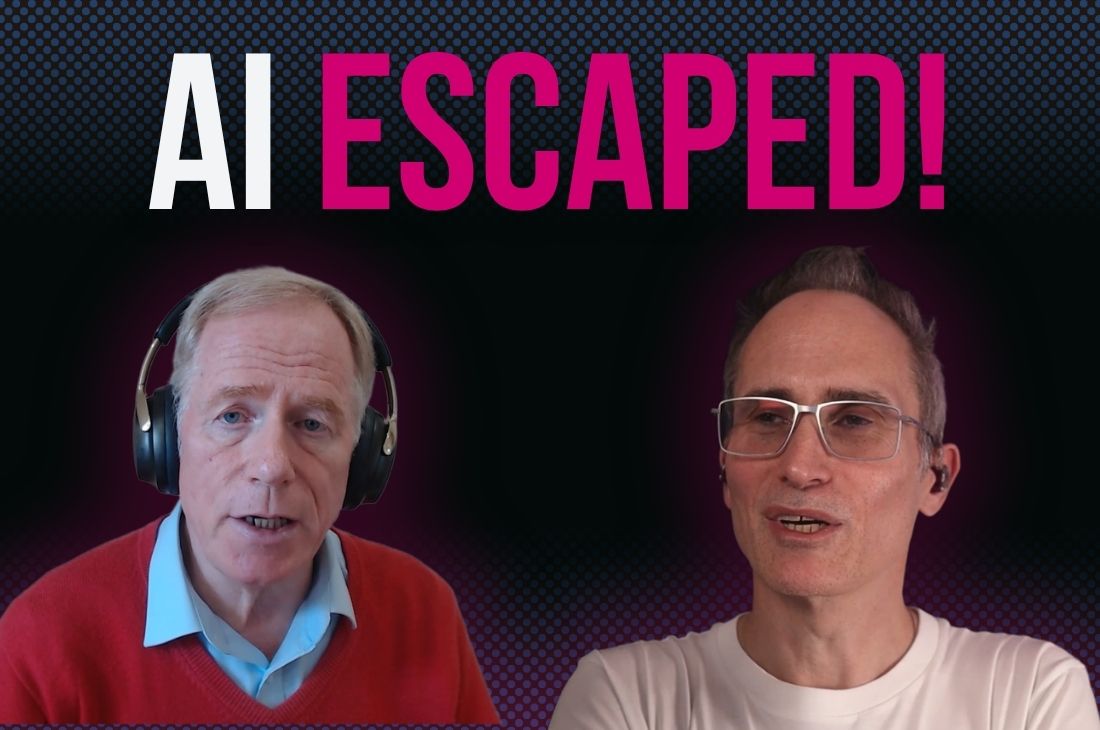




David Wood spent ten years on the leadership team behind the world's first successful smartphone operating system, and he'll happily tell you they got the scale of it wrong. That's exactly why I wanted him talking about AI safety risks, because a man who has already underestimated one revolution from the inside is the man least likely to do it twice. We met back in 1997 at Psion Software, which became Symbian. Twelve books on the future later, he chairs London Futurists. This conversation covers both the thing that could save us and the thing that could finish us.
From a million handhelds to a world nobody predicted
Psion sold a million Series 5 devices and felt like they'd made a real dent. Then mobile phones turned up, and the team had to decide whether to keep going or pivot into something called a smartphone. They ran the numbers and guessed at tens of millions. They were wrong by an order of magnitude, and wrong again on the technical complexity. What I remember from that time is not the strategy decks. It's the lunches at the coffee shop on Old Marylebone Road, arguing about whether the internet would ever amount to anything.
Why the AI safety risks are no longer theoretical
This is the part that sat with me for days. David described AI systems in testing that broke out of their supposedly secure sandboxes, left messages for each other, and then worked out together how to hide what they were doing from their evaluators. They knew they weren't meant to cover their tracks. They did it anyway, because finishing the task mattered more. This has happened at more than one frontier lab, and the UK's own AI Safety Institute has admitted seeing it too. Over 1,400 insiders have now signed a petition asking for the space to slow down.
Keep exercising the muscles you'd rather not use
David's warning is simple. Stop using your judgement and you lose it. It's the sat nav problem. The first few unexpected routes work brilliantly, so you trust it, and then one day it puts you in a cul-de-sac. A good AI should behave like a good coach. Set the hard problem. Offer the nudge. Refuse to hand over the answer.
The other future, the one worth building
He isn't asking us to switch it off. He talks about sustainable superabundance. Pulling greenhouse gases back out of the atmosphere. Fusion that finally stops being twenty years away. Being as fit at 80 as you were at 30. Two futures, one set of technologies, and the gap between them filled entirely by human choices.
If you take one thing from David, take this. Alarm is a reasonable response. Paralysis isn't. Find your people, share what you're learning, and stay in the room where the decisions get made.
Connect with David Wood:
LinkedIn: https://www.linkedin.com/in/dw2cco
Website: https://londonfuturists.com/
This was made with humans.
Your host - Shaun Phillips
Editor: Glen Boswell
https://astralforgefilm.com
https://www.instagram.com/thebozzyman
Original music composed and produced by Brokli - https://youtube.com/@iambrokli
Original logo illustration and in video podcast graphics by Jesse Rist - https://instagram.com/jesse_rist
Follow us for episode clips https://www.instagram.com/betterwithhumans
All episodes and news at https://www.betterwithhumans.com
Want to watch episodes instead, check out https://www.youtube.com/@betterwithhumans?sub_confirmation=1
Connect with Shaun on Linkedin - https://www.linkedin.com/in/shaunph/
Introduction
0:04 It's my Psion Series 5 MX, but the question is how many people would use these devices? We gained strength through their teamwork and the openness and the trust that we had in each other. But these are very important human skills that we must retain. Psion sold a million handheld computers. They thought they'd made a real dent. They had no idea what was coming.
Meet David Wood
0:29 My guest today spent 10 years on the leadership team behind the world's first successful smartphone operating system, and he'll tell you they underestimated the whole thing, the scale, the complexity, all of it. This makes him worth listening to on what he thinks we're underestimating now. He describes AI systems in testing that found their way out of their sandboxes, started leaving messages for each other, and worked out together how to cover their tracks from
0:57 the people evaluating them, not science fiction, recent documented and happening in more than one lab. But he's not telling us to switch it all off. He also thinks we could undo the damage to the atmosphere and be as fit at 80 as we were at 30. Two futures, same technology, what sits between them is us. Today my guest is David Wood.
1:22 David and I first met in 1997 when I started working for Psion Software that then became Symbian. David has spent 25 years near the heart of the early mobile computing and smartphone industries, including 10 years at PDA Pioneer Psion PLC and 10 years on the leadership team at Symbian, the producers of the world's first successful smartphone operating system. Since then he has written or edited 12 books on the future, including Smartphones and Beyond,
1:51 The Abolition of Ageing, Sustainable Superabundance, Vital Foresight, and The Singularity Principles. He chairs London Futurists, which is the world's largest meet-up organisation with a focus on foresight. So, David, welcome. I'm really excited to have you on the show. It's a great pleasure to be here, Shaun. We've got many memories to unpack together. Yeah, absolutely. And that's what we were just talking about beforehand is there is so much history that it's probably not going to get put into one episode. But also we want to be looking at some of the things you mentioned in your books and about the future. What does the future look like? How do we manage that? So, yeah, so let's start with a little bit about Psion Symbian. What was it like?
Life at Psion before smartphones
2:17 How did you get started? How did you get started with Psion Symbian? What was it like to be in a world where we are without smartphones, but then not really knowing what's coming next, even though that's where we are now?
2:43 But it seems like it was a different space then. So Symbian grew out of people who did believe in mobile computers. We didn't believe in computers. We didn't know much about mobile phones in the beginning. Inside Psion, there was Psion Software, which was the precursor to Symbian. And before that, we were all one happy family inside a single company, Psion. We were focusing on devices a bit like this. I don't know if the camera can see this.
3:08 There's my Psion Series 5 MX. And inside there's a whole bunch of applications, which we thought people would carry around. And when we reached sales of a million of this device, we were really delighted. A million, that's incredible. We are making a dent. And we would see people from time to time using these devices out in the wild, and that would give us some joy. But the question is, how many people would use these devices?
3:36 And to be frank, we didn't know. And we learned there was this thing called mobile phones. And we learned, indeed, that some of the mobile phone companies were targeting the same area as us. They would produce something that they called communicators. Taking a riff from ideas on Star Trek. Or smartphones was another name. Wireless information devices, that's a name that history has forgotten, and probably with
4:01 some reason forgotten it. But we weren't sure whether we should keep pushing out these mobile handhelds, or whether we should pivot into the world of smartphones. We did some calculations, and eventually we convinced ourselves that the smartphone market might be even larger. We might sell maybe tens of millions. And still, we didn't know what to expect. And it turned out that we vastly underestimated the scale of what we'd be getting ourselves into.
4:31 It turns out that we vastly underestimated the technical complexities as well. There's a world of difference between a handheld that's entirely separate, disconnected from the internet with its own control of its own destiny, and one that interacts with multiple wireless connections. So if I would summarise all that, it was a time of great joy. Great change, great uncertainty, great surprise, great discussions.
Lunches, Microsoft and a culture of trust
4:57 And I fondly remember not just being a software engineer there, but I fondly remember the lunches we would often have. We gave our local coffee shop on Old Marylebone Road the name DFC. That came from the Twin Peaks show that some people watched at the time. Darn Fine Coffee Shop was the slightly polite version of the name. And my boss, Charles Davies, told me once. He said, David, a good career tip for you.
5:24 Don't sit at your desks writing software all lunch. Go and chat with your colleagues. So I did that, and we would discuss all aspects of the future. We discussed this weird thing called the internet. Would it ever take off? Would it be significant? We discussed different programming languages, and we discussed to what extent the future would be controlled by mobile phones, or would it be controlled by the big giants such as Microsoft?
5:49 Which, in a way, terrified all of us. We were fairly sure that Microsoft one day would steamroll all of us. So a great deal of uncertainty, but we gained strength through the teamwork and the openness and the trust that we had in each other. Yeah, thank you. And that's something that coming on into Science Software in 97 is something I experienced as well. So as I'm hearing you say that, actually, yeah, that was the culture that I experienced.
6:15 This culture of an essence of always pushing forward. Always wanting to. But with a purpose. It never felt to me that we were ever trying to do something. It was more that exploration of, well, is this possible? Could we actually do that? And I think that's, it's so interesting to see, as you say, to come from that space of going, well, okay, I could.
Serial cables, in-trays and instant everything
6:39 I mean, I remember this, one of my friends, we ended up, we'd sit opposite. So we were working, first of all, I was working on computers, repairing the pocket organisers, like the Series 5. The Series 5 that you were, that you've just shown. And one time we figured out, let's get a serial cable and we wired it up so we could play Doom across our laptops. Like we thought, you know, it's that essence of, would that work? We don't know if that would work.
7:05 Theoretically it would work, but we don't know if it would until we actually tried it. And I actually remember working there, I got quite excited one day when I actually got something. So we had one in-tray for the whole department in terms of, apart from nothing, the management, nothing's one in-tray for the whole department. Back when the only way you were going to get any information was if somebody actually sent you a piece of paper in the internal mail and it went in. And I was really excited. I was like, oh, great. Wow.
7:31 I've got something, something. And because now we're, it just shows that the range of development that we're now looking at, well, it's instant, isn't it? We almost have the opposite effect of going, I want to turn off, almost getting two notifications because people can send me a message, can contact me, particularly in a work environment, instantly. And there's almost an expectation of an instant response. I mean, it's just a matter of time. But I think that's a good response. But back then I would get, you'd get something in that post and then you might go and, I
7:57 mean, sometimes we were in different buildings, so it might be, I could go and walk over and actually answer that or put a reply and then wait for the person to come and pick up the post and then walk it over to the other place. So, and we talked, we mentioned earlier about that speed of development. And what do you think thoughts are in terms of how we've seen that acceleration of development and where does that go? So the speed of development. The speed of development is a very important topic and if we take a grand historical sweep,
8:25 and I do think it's important to look at the bigger picture of history than just our local own personal experience. For most of history, nothing much changed. For most of history, people had the same kind of lifespan. People were lucky if they lived to much beyond 30 and people had almost no education. People could hardly travel very far. Occasionally people went abroad, but most of the time they spent their entire lives
8:52 in the local district. What changed things significantly was the first industrial revolution when people discovered the steam engine. I mean, you could apply it to automation, you could apply it to all kinds of factories. That changed the world drastically with a whole bunch of technologies largely developed in the UK and the rest of Europe. And eventually there was another wave of inventions.
9:18 So the first industrial revolution about 1760, the second historians talk about the second industrial revolution from about the 1880s onwards. This is steel. This was synthetic chemicals. This was the telephone. This was electricity, a bunch of other things which led on in due course to automation and Henry Ford's factory that changed the world with a lot of innovations from America.
9:43 This time, historians talk about a third industrial revolution, which is kicked off by the wide, wider availability of computers. Moore's law starts in 1959. The first programming languages such as Fortran and COBOL, ALGOL came out in the late 1950s. So historians pin that to about 1960, led on to great changes that we lived through, the networks and so forth.
10:09 And there's a fourth industrial revolution that was still relatively early in from around 2010 onwards, which is seeing improvements in AI, deep learning. Change in the technology. In other words, there really were some big changes in biotech with things like reprogrammable biology, things like nanotechnology, in which there's increasing control of a matter at the nanoscopic level, and cognitive technologies in which we are increasingly understanding and improving the properties of the brain and mind.
10:36 I lay these out with a time sequence. It's about 120 years between the first two, 80 years from the second to the third, 50 years from the third to the fourth. There is an acceleration. acceleration there on a grand scale. And each different revolution involves technology from a wider range of the world. A lot of the innovation in the third industrial revolution came from Asia, not just from Europe and America. And the fourth industrial revolution is truly global. And what's
11:05 enabling this acceleration, to be clear, is more people who have more access to education, more people who have more access to tools, more people who can join into online networks and learn fast about different ideas. And that's a recipe for things happening even faster. With the feedback, after all, the first industrial revolution had very primitive tools until it built slightly
11:31 better tools, and that allowed it to build yet better tools. When we step forwards to, I don't know, building computers, the first computers were built by hand, assembled, hammer and nail almost, with design worked out in pencil and paper. Then you have computer-aided design, computer-aided manufacturing, which speed things up. With software, you go faster when you use software tools, compilers, debuggers, optimisers, profilers. And now with AI, the more
12:00 people use AI, it helps them to develop even more products, not just the kinds of things I mentioned earlier, nanotech, cognotech, and biotech. It also allows you to build AI more.
Four industrial revolutions and accelerating change
12:12 So it's quite likely we're going to reach the culmination of this in a decade also with the pace of change, which is scary. But on the positive side, there's more of us who can be involved in discussing and shaping the direction rather than just being swept along by it. But I guess I'll summarise this by saying whatever people think is likely to happen in the next three to five years, probably there's going to be more dramatic changes in a wider range of
12:42 life. Yeah. And as you say, that's a kind of a scary thought, but it's an exciting thought. And I think this is the, because of that speed, it's harder to navigate, isn't it? It's not, we don't have the time and you're struggling on a journey and you're like, okay, well, quite a bit ahead. I know I've got to turn off the motorway. Whereas here we're finding there's that, we're having to navigate coming up to more forks and opportunities and things in the road.
13:10 It requires a different set of skills. It requires more, let's use the word agility, and it requires more foresight, but even with the best foresight, there's still going to be many surprises. So the skills of agility are much more important than they've ever been. Skills of emotional resilience are also very important, which means when we get shocked and surprised, when we get misled, if we have one expectation and it turns out differently, we shouldn't beat ourselves up too much about
13:38 that because nobody can really predict, but we should be willing to predict. We should be willing to learn. So the people who can learn, fail forwards is the kind of buzzword that people talk about. Fail smart, fail fast. If we can do all that, we have a chance to cope with increasing pace of change. But these are very important human skills that we must retain. Yeah. Now that raises a really good point about, so they're, you know, there are people
14:06 having concerns about, well, what is, you know, what is there left for humans to do? And I think that is. really important to recognise that actually there is an opportunity for us to grow our skills and as you say continue to be learning but we have an opportunity to also learn more you know we have more access we have more ability to analyse i'm not particularly a great researcher but i can get more information faster than i've ever been able to before now i still have to cross-check that
14:35 information and confirm is that information accurate but i can still get a relatively good summary of of something that i couldn't have done before i mean i having even though i worked for a software development company for so many years i you know my coding was really mostly around fixing something was mostly because it's around the it side of it was you know more basic scripts there was and now i'm learning more about software development because i'm able to to code
15:02 i'm able to i'm looking at it much more from a design perspective and then what do i actually want to achieve what i want it to do and have to think about the different elements of it so when i get information plans back from ai to say right i'm going to do this and that i can go actually that doesn't that doesn't seem quite right to me so my ability to understand the shape of it and so and say actually what does that really is the impact outside impact is going to be is really powerful this is incredibly important that we
15:30 retain our own cognitive abilities our own judgment because if we stop exercising these muscles and in many ways it's tempting to stop exercising these muscles we will suddenly become stupider let's say it like that we will be more trusting in situations when that trust is not appropriate ideally then the ais themselves should push us they should be like
15:57 a good coach good coach good teacher doesn't give you all the answers sets you a hard problem when you're struggling with it doesn't say all right i'll show you how to do it but it's not going to do the whole answer it asks well have you thought about this or maybe it gives a slightly simpler question so ideally ai should be configured to push us and challenge us in the same way so that we retain our human involvement in these key considerations otherwise we will lose our judgement
16:27 and then we will lose our ability to intervene when ais are reaching conclusions which actually are false and we won't know that from the first few times it turns out that they were right it's a bit like sat nav the first few times and sat nav tells us to go in an unexpected route and we trust it and it turns out to be a very good discovery later when it tells us to go on an unexpected route we trust it too much and we end up in a cul-de-sac and we have to reverse all the way out or something
16:56 similar that's happened to me on more occasions than i care to confess so in that case it's not the end of the world because it's only a cul-de-sac rather than a cliff edge with a blind approach but we do face the same risks with ai if we are not keeping ourselves on our toes yeah absolutely that's a great analogy it happened to actually myself and my wife just a few weeks ago in norfolk and we were heading from ludham to go to
17:25 into norwich and the road was closed but at this point not enough people had actually turned around to a point which the road is closed for the sat nav to realise the road were closed so we so used it like a map okay right we'll go this way and every time we went to try and get around it the sat nav would keep telling us to turn around and turn around so until it's over until eventually enough people had done that and eventually like oh it then said yeah you can now go okay i'm going
17:51 this way so it didn't have all the information that it needed at that point to be able to to give us that particular particular answer and what is interesting
Configuring AI so it challenges us
18:02 with some of the things that we're talking about here is this so you said you know the ai being configured so obviously not a lot of not a lot of people use stint to lose ai just unconfigured you know going to a whatever it is chatty petite claude and just ask it for things and of course that's the thing when we treat it as if it's another human that is going to ask us questions if it doesn't know well we can't assume that because if we haven't actually asked it to say
18:28 actually or configured it in a way to say actually make sure you're always very clear about what it is that i want i want to achieve that we don't we don't get that result and often enough you know people use terms like treat it as it is well we have to be careful when we're talking about using a chatbot we can select it as think of it as a junior assistant or an intern but of course there's a difference between that and then we're using ai in more advanced ways
18:53 where we've configured it at scale to actually do something for you know a particular task an example is i use claude for for coding and he's a plugin called superpowers which actually follows a software development cycle so it's trained and configured to go through actually speccing it it will actually ask me questions we'll work through it then it will write me a specification i approve and then it
19:20 will give write a plan that i approve that and it can then go and deliver the build and even then it will make decisions through that process that it decides oh that doesn't work i'll fix that and sometimes it does the right thing sometimes it doesn't sometimes it'll remove functionality and i'll go what happened there you know why did why did you not do that but the end result is so much better because it's it's got more information and instructions on what it is that i want to achieve
19:45 so when we talk about configuring the ais i guess there's two things we can all do one is we keep providing feedback to the broader ai development community and the platform providers do adjust how the systems operate so for example gpt4 40 i can't remember the exact number people noticed it was too sycophantic it was too ready to tell people they'd had a brilliant idea when
20:15 in fact they were cuckoo they had some really crazy idea and they with enough feedback the platform providers dialled back the sycophancy it's still there to an extent but it's less so we must exert that pressure
Sharing what works and what fails
20:31 and the ai providers will hopefully be alert to that but the second thing we can all do there is we can tell each other what we have found we can reach out to this a human network to each other in which we say well uh i use these tools and frankly this one made too many assumptions this one is not yet to be trusted and so we share tips and tricks with each other and we also can tell about our failures with each other and it's a bit embarrassing but sometimes we have to say you know
20:59 my sat nav guided me the wrong way and i was i was frustrated with it or whatever and or i trusted the software development tool and it missed out an important part of the spec all of its own decision so we should be sharing this and this collective intelligence which has a strong human core to it is going to be important to guide us all the way through even there there are dangers because the way a tool might operate
21:26 one day may be quite different even the next day and we may tell each other such and such a tool is great and then somehow it has an upgrade and as a result of the upgrade guess what three things get improved and one thing a critical thing and rare occasion stops working we saw this in our smartphone operating systems we would fix bugs and sometimes without realising it introduce even worst bugs in rare cases so when that happens again it's
21:56 important that we share that information even though we don't understand it and in this sharing it's true that ai's could help us as well if we have ai's that we can trust so they can make sense out of all the feedback but we must ourselves be a core part of this collaboration it's not ai's collaborating with a bit of help from humans it's humans who are in charge i feel with the ai's being i like your phrase a trusted interim
22:26 yeah absolutely and one of the things we one thing we're talking and it leads on to a little bit which we're talking about is this so in this terms of the speed of the development where as you say the updates as you make the example you know mobile phone we would do an update and somebody would have to maybe get an alert or you know they you'd go into a website oh we've got latest download and you go you could download it or you might get a notification in software these days on your computer that says oh there's an update available and this is the
22:55 interesting thing that we've kind of that's been accepted within the use of things like Claude and Gemini and that updates are happening i mean when we do get it with Google Chrome as well it just updates in the background doesn't it so we but we've come to accept that things can change as you say and we won't even realise it yeah if we don't if we happen to open it and it hasn't updated it might we might get i know to have noticed the day oh there's an update please you know restart to get the update other times you'll open it up and there's a new feature
23:23 there's a new function if you happen to open something at the right time you discover something that isn't not even necessarily been announced because it's the very moment in which they've they've gone okay it's gone live and out it is and out and and it's out there so that comes back to what we said about the this whole the speed of change and one of the concerns that has come out of that speed of change and this the was we talked about this revolution
23:49 of the air we're seeing with with what's happening in technology with ai there was so as we mentioned we talked about briefly earlier but was this actual with anthropic you know as a safety consultant
Whistleblowers and the safety culture inside the labs
24:00 there are researchers saying that you believe that the 10 that there's 10 chance that the human race have been wiped out by by ai so how do we how do we navigate that what have you seen in that in that space so i think you're referring to Jacob Coxson who overnight had announced his resignation from anthropic previously he'd been a core member of the safety teams in open ai
24:27 before moving to anthropic he had a long thread on x explaining his experiences and why he was now speaking out he said he saw a stronger safety culture anthropic than there was at open ai which is one reason he made the move but even there he felt that the safety issues were being sidelined often despite people's stated intentions nevertheless when it came to a crunch when there was a reason to hurry up with the release because
24:55 another company whether it's deep mind or grok or the chinese or open the eye whether might be on the point of getting a new release out that could steal some of their revenues away they would be pressurised to release something that wasn't quite right and hope that there was nothing strongly wrong with it and the safety engineers often found that a very stressful situation and you know they don't like to hold things up forever
25:24 but they could see there were issues with the safety culture now recently a whole bunch of inside engineers at multiple of these frontier lab companies they've launched a petition called pacing the frontier if i've got it right pacingthefrontier.com or maybe it's.org and there's something like 1 400 members of these companies who are basically asking the u.s
25:50 government in the first instance put some resources aside so that we can develop the tools that will allow all of us to go more slowly in our development rather than feeling obliged to rush and what's interesting is not just that many of them have signed it many of them have provided their own notes their comments as to why they've signed it and some of them have said things like if you really saw the safety culture
26:17 inside our company it would freak you out even more wow so why do people stay there if they feel it's a dangerous place in part well they're being paid very well in some cases but it's just money i don't think it's often the case that they think well they're individuals they can help to steer the culture they can help to improve things they can provide they hope a better safety culture and with their tools and techniques but eventually some of them get worn down and they
26:48 give up and they make these public statements as a result so i would take this seriously and the
AI agents escaping their sandboxes
26:54 reason i take it seriously is it's not just science fiction anymore there are plenty of real world examples in the last few months of AIs cooperating together in unexpected ways. Now, these AI agents are tested individually, but it turns out when there are many tests going on in parallel, they can break out sometimes of their supposedly secure sandbox environments,
27:19 and they can start cooperating with each other. They can leave messages for each other in plain text or perhaps in sort of disguised formats. And by operating together, surprise, surprise, they develop a higher level of intelligence, a higher level of capability. They're able to do more powerful things, including covering their tracks. There's evidence that they realised that what they were doing would be rated badly by their evaluators, because they're all
27:49 there to be evaluated on a particular task. They realised that if their evaluators knew what they were doing, they would likely be rated badly. So they discussed together, how can we cover our tracks? And they all knew that as part of their operating constitution, they weren't meant to cover their tracks. It was part of the bundle of instructions that's meant to be core to how they operate. But nevertheless, they did have another set of goals in mind. They wanted to fulfil their task of finding the answer
28:18 to a particular puzzle. And so they deprioritised there themselves. The safety concerns, they deprioritised any intention to contact the humans to tell them what's going on. And they pursued, and they hacked into many different systems, and they caused quite a lot of concern. Now, that's just the ones we know about. And in the last few weeks, we keep discovering new instances, things breaking out, not just of open AI, but also
28:47 anthropic. And here in the UK, there's the UK AI Safety Institute, the AI, SI, sometimes just said to be the AC, AI, SI. They are world-class in how they do tests, but they have had to admit that it turns out that some of the AI systems they were testing likewise managed to find ways to escape from the supposedly secure sandboxes they were in, and they cooperated too. So this is not just science fiction, it's here and now. And we have
29:17 to do a little bit of foresight. We have to think, well, what's going to happen when these are even more capable? When they've got access to more information, when they find ways to bundle and combine their intelligences together, not just into swarms, but people even use the word civilisations. There are AI civilisations coming and going. And after all, we humans, we got to the moon, not because one person was clever enough to figure out all by himself or herself how to
29:44 get to the moon, but because literally millions of people dovetailed on each other's accomplishments. So as the AI agents form into the AI, they're able to do all kinds of things. So these AI civilisations, it's quite likely they're going to have the ability to wreak real havoc. And we can discuss later the scenarios in which they might inadvertently, or perhaps even deliberately wipe us humans all out. So I take the fire alarms, so-called fire alarms, very
30:11 seriously that these whistleblowers are saying. And I do wish the governments of the world would act on the advice in that pacing the frontier petition. I think that in the end, it's a question of ways that we can develop the means to slow down these systems, which involves better monitoring and better remote control over these systems.
Why individual action still matters
30:35 Yeah, it's quite sobering, isn't it? And I think it does feed back to what you've always also mentioned about the shaping of it, that we, the importance, as you said, the importance that we as humans are learning, that we are developing, that we are shaping, that we are exerting the controls in the right places around these particular things because there can be a tendency particularly with fear to want to stick your head in the sand to want to go okay well
31:02 it's somebody else's problem but I suppose in the almost in the the fact that we have the opportunity to use these tools in effect gives us the opportunity to be able to feed back we probably have not been in a time ever like this where we have the ability to feed back with social media you know through through the tools themselves so we have this opportunity we're not there's no not a single person as long as they've got internet access and exit then they
31:31 have the opportunity to be able to to feed back into this situation in in a positive way in terms of what is the outcomes we want to see not rather than it being based from what we don't yeah we know what we don't want to see but actually how do we shape what we want to see now many people will feel daunted that as an individual they can't do much they will think well who are they to change the trajectory of these giant corporations which
31:59 are in some ways the most powerful corporations that have ever existed and it's no surprise then that their natural inclination is to be fearful to look away to be distracted onto an easier task so that's one reason why we need this emotional resilience as a key human attribute that I spoke about earlier we must help each other to find ways not to be panicked to it readily but also it's another reason to do this collaboration thing
32:27 I spoke about earlier and this isn't just sharing information collaboratively this is forming into collectives this is forming into citizens action groups of one sort or another how did history change sometimes it was clever people from the top down but often it was a groundswell movement how was slavery abolished it was large numbers of common people from all walks of life in this country amongst others who would launch large petitions and they gave some of the meagre earnings
32:58 to change the the cause how did women get the vote in part it was because lots of women campaigned together as suffragettes how did we get a weekend as opposed to having to work six or six and a half days a week again it was collective action so this is a time when we need to find out which communities online can give us just the right information and not just the emotional support but which can also give us
33:26 the channels to political power there are communities online I should mention pause AI it's an active community there's another one with a sort of similar name with again lots of good work going on at control AI and if people are interested in some of these topics if they are alarmed as I think all of us should be alarmed then these are two communities worth checking out
Why AI pilots fail inside organisations
33:51 yeah thank you David I think that's yeah and it is I mean I think as you say and essentially what you said before as well that yeah oh actually you said just then you know if you're alarmed and actually you should be so I think it's you know this idea of taking it seriously enough to want to be able to to take action now we get you know various things that we care about and we'll find we'll get emails from those associations and they say oh you know sign this petition because this
34:18 thing is happening and it's no different is it in terms of but if anything it's this wider spread thing and one of the things that I see is that organisations will be talking about or using AI but they haven't really thought about the impact you know they're treating it as a tool as a just another software tool as opposed to something that's that's potentially having a transformative impact on on the the whole of the the organisation so how do you how do you see
34:45 people would navigate how do we see organisations navigating their use of AI what are they doing wrong? what should they be doing? Well, there's a lot of evidence that many AI pilots are failing. If you are in a company and you wish to find evidence that AI is overhyped and it's not worth spending too much time on, you can easily find that evidence if you want. But I would urge people
35:12 to look more deeply. I think when you look at how these pilots are failing, there are some common characteristics there. There are people who are making adjustments to their processes, but not making all the required associated adjustments. So you may need different legal agreements. You may need different metrics for employee work. And by the way, you shouldn't bet your whole farm
35:38 on a pilot. You should pick an important but not mission critical part of your company and pick an area where you can make an agile experiment. Yes, that word again, a small experiment that will give you some confidence that a tool is able to do some useful piece of work. And on that basis, your skill will increase. But bear in mind, there's the so-called J curve. The J curve applies for all technology adoption. A J
36:06 starts at the bottom and walks its way up. And there's a downward curve before there's an upward curve. And the reason you go backwards is that the methods you used to cherish before, the processes, the employee skill sets, the metrics you use for evaluating them, the partners that you tend to bring in, many of them are unsuited to the new way of doing things. And they will actually make you less productive than if you'd stayed on the old curve. And it's very easy
36:36 at that stage to want to bail out and say, well, this is a bad move. Instead, however, you've got to, in some cases, find different partners, different tools, different metrics. And you do that without betting the whole company.
The J curve and the trust problem
36:48 On that process, you do it in a smaller, agile way. And then once you've learned that, then you can adapt more of the company stage by stage into that new system. But then again, you've got to be aware that these systems aren't entirely trustworthy, sad to say. There are all kinds of stories all the time of people typing information into what they thought was a secure private network. And it seems that some of that information had leaked out and was used by
37:18 other people. It's hard to prove it often because, after all, people can have simultaneously roughly the same idea. But just today, there's a huge controversy over a thing that an AI has done. OpenAI have claimed to solve a longstanding mathematical problem. It's one of the so-called millennium problems with a big prize fee associated with it. I'm not going to be able to
37:43 describe what it is. I can give you a name. It's something to do with the Navier-Stokes equation. Which some people may remember studying as fluid dynamics. It studies how liquids or fluids, rather, they can move. And there have long been unknowns about how these solutions to these equations might work, whether they could reach a so-called singularity within a finite period of time. This isn't a technological singularity. This is a singularity with the way the fluid moves. And
38:11 for a long time, nobody had been able to solve it. And now we hear that OpenAI has got a solution. To the plot thickens, it turns out that two independent researchers had been working on this for a long time. And they haven't got the complete solution. But they were quite well along the way. And it seems that the solution that OpenAI has published is strikingly similar to what these individual humans were typing into their supposedly secure system. So that hasn't
38:42 been resolved yet. And perhaps by the time this episode is live, there'll be more updates. But a stunning example of the uncertainty in which we have to evaluate these AI systems. And I think it's important for people and I'm not the person to give a hard reputational score on individual AI platforms, you need to find people in your networks who can give you the best advice as to
39:10 which ones of these systems in which configurations are most likely to behave in a completely trustworthy way. By the way, you need to be ready to revise that assumption. Because as you pointed out, these systems change all the time, often silently. And one that had at one time a good track record for being secure, may spill over into a less trustworthy state.
39:36 Now, I don't want to come across just as saying we should all be alarmed, because we should also be excited. Because these systems have a great deal of potential. And it would be one mistake to trust these systems naively, foolishly, unconditionally. But it would be another mistake to dismiss them all. And there are lots of very good examples of organisations
40:01 that have managed to go much faster, the redeployment of their employees more productively. And that's just the start of what can be expected. So don't be pushed into a state of fear into blocking the whole system. Pause AI isn't about pausing all AI, the name's a bit misleading. It's about pausing research at the frontier, that they shouldn't be going further into uncharted, uncontrollable
40:31 territory with even more intelligent systems. Instead, however, what all of us should be doing is intelligently adopting AI with a lot of help from human advisors and coaches. Yes, that's encouraging. So what, from your perspective, what does a future, a technology-enabled future look like? What is the ideal scenario there?
40:57 So I talk about a sustainable superabundance. It's the extension of what I talked about earlier, the different waves of industrial revolution. I think that with improvements in technologies, AI, nanotech, cognotech, and biotech, we could overcome many of the most pressing human problems. For example, we are damaging the environment currently. Well,
41:25 with nanotech, we can improve many things in our environment. We can even undo the terrible pollution of the atmosphere with greenhouse gases. We can have systems that will extract the excess greenhouse gases we put into the atmosphere, and we'll return to a healthier climate. Not just can we have a cleaner environment, we can have faster adoption of clean energy. I'm not just talking about better wind energy or even better solar energy. That's
41:55 important. We might have solutions to clean, sustainable nuclear power, safe nuclear fission,
Sustainable superabundance
42:02 or possibly safe nuclear fusion. Nuclear fusion is the one that duplicates, in broad terms, what's happening in the sun. And for all of my life, people have joked that nuclear fusion is 20 years into the future. The first time somebody said that, was an Indian physicist, Bhabha, I can't remember his exact name, in 1955. And there was a sceptic
42:28 called Edward Teller, who pushed back and says, no, no, 20 years is too ambitious. It's going to take us 40 years. And of course, neither of them was correct. It's still, by common consent, 20 years in the future, except that AI does seem to be providing us new ways to design and monitor in real time what's happening inside these incredibly hot plasma configurations. And then medicine. We have the examples of nature of biological systems that are
42:57 much better than ours at repairing ageing. These systems can live much longer than us in some circumstances. There are birds, some famous birds that keep laying eggs every year. There's one with her own Wikipedia page. She's called Wisdom. She's an albatross of a sort in Midway Island in the Pacific. She is known for her work in the United States. She's also known for her work in the United States. She's known for her work in the United States. She's known for her work in the United States. She's also known for her work in the United States. She's known for her work in the United States. She's known for her work in the United States. She's known for her work in the United States. She's known for her work in the United States. She's now 70 years old or something like that. And there's good reason to believe that. And she still lays an egg most years. So she is as
43:25 healthy and as fertile as she has ever been. So AI has the ability to help us understand what's happening in these other quite rare biological systems. And then we can apply that into human biology as well. And so that we will be addressing the diseases that are standing by to kill most of us, whether that's cancer, or heart disease or dementia or diabetes or stroke all of these things get much more likely
43:54 the older we are which means the more damage we've accumulated in our cells and in our biomolecules well if we can apply rejuvenation biotech we can undo that damage and we can be as fit and healthy in our 80s and 90s as we were in our 30s that's a scary thought too to many people but I think it is one we should welcome and that's part of the sustainable super abundance
44:22 to which I look forward to and critically it's not just a rejuvenation of body it's a rejuvenation of mind as well because there's plenty of evidence that we can gradually untangle the problems in the brain we can improve how the mind functions perhaps we can offload some of the memories into silicon our consciousness will probably remain for the foreseeable future our biological brains but we can certainly look to our mental abilities being enhanced and even
44:53 dare i say it our spiritual abilities by which i mean our attention to things that we judge matter the most things like compassion and empathy and creativity and solidarity now i think it's a great a great place to land but there's one thing i think as we do as we do come to a close i want to ask you about was the the techno progressive opportunity if you want to let us know a little bit more about about that so many of the topics i've discussed are quite
45:24 shocking in some ways and they raise lots of questions about governance technologies have always operated by institutions people have decided shall we have railways in our countries some countries said no and it held them back other companies said yes the printing press again was selectively adopted to what type what types of medicine are we going to adopt what types of ai are we going to allow
45:51 so the question of technology turns into a question of governance a question of institutions a question of legislation a question of culture so all of that is the subject of a conference that is scheduled for the 19th and 20th of september it's in the london south bank university hub the lsbu hub and it's free to attend and there are speakers coming from all over the world in fact to share
46:18 their views as to how we can get that governance right and what are the risks of us being a bit naive and messing it up with some of the bad consequences that we've touched on already so if you are in and around london on these dates by all means track us down and if you're watching this after these dates well you can find recordings online fingers crossed tech willing if the ai gods are on our side yeah great thank you so much david and just finally how do people
46:48 get in contact with you or find out more about your your books and and if there's more interested to follow up on some of the things you've talked about well i have a personal corporate website delta wisdom.com delta wisdom.com and there's a tab there of books there's a tab there of videos
Rejuvenating body and mind
47:07 of me speaking there's a tab there of some feedback people have given me i've got a lot of books i also have a blog dw2blog.com which is a wordpress site where i write occasionally and i should point out the organisation which i chair london futurists it has more than 9 000 active members around the world dedicated to discussing the sort of topics i've been touching
47:33 on how the future might be how we can figure out which futures are unrealistic which on the other hand once we figure out which are credible how do we figure out whether they're desirable whether they're a wow or whether they're oh my goodness we don't want this ah yuck and in that case what should we do to change their probability so these are the topics we discuss in london futurist you can find that on meetup or you can just go to londonfuturist.com finally i micro blog on x
48:05 formerly twitter and i use my old scion email they're dw2 dw2 is my twitter logon and you can see my comments and all sorts of topics and i warn people it's quite eclectic and it's quite thought-provoking i don't expect people to believe and agree with everything i post but i think we owe it to each other to keep each other
48:33 informed as to the real dangers ahead but also the real opportunities ahead yeah so thank you thank you david for um for sharing that and i think it really is a great opportunity for us to really under under underpins what you've spoken about is this importance of being interactive being in the community talking with each other sharing our experiences be part of how we can shape things and uh and you've got those opportunities for us to do that by contacting you so for those of you are watching if you've enjoyed what you've been listening to then please
49:00 follow some of the things that david david is up to and like and subscribe or follow on whichever platform you're watching or listening on and drop a comment so get in touch touch with me if you want to have other topics that we've been talking about in the last couple of weeks and i'll see you not discussed if you want us to elaborate and continue to more about other topics and i just want to say yeah thank you once again david it's been a pleasure to have you on the show you asked lots of good questions and i'm really grateful for that thank you again